

In emergency standby power systems, data centers, hospitals, and industrial facilities, diesel generator sets often operate under low-load conditions or remain on standby for extended periods. However, many users are unaware that this operating pattern can easily lead to a serious yet frequently overlooked issue—”Wet Stacking”.
Wet stacking not only degrades generator performance but also shortens equipment lifespan and may even cause failure at critical moments.
What Is Wet Stacking?
“Wet stacking”occurs when a diesel generator operates under conditions where fuel is not fully combusted. Unburned diesel fuel, carbon particles, and moisture accumulate in the exhaust system, eventually forming black, sticky liquid residues or carbon deposits inside the exhaust stack.
The term “wet stacking”originates from the characteristic appearance of “wet, oily deposits”found in the exhaust stack.
Typical symptoms include:
– Black, oily liquid dripping from the exhaust outlet
– Continuous black smoke emissions
– Heavy carbon buildup in the exhaust system and turbocharger
– Sluggish engine response and reduced power output
How Does Wet Stacking Occur?
Wet stacking is “not a manufacturing defect”, but rather a result of improper operating conditions. The main contributing factors include:
| Primary Cause | Explanation |
| Prolonged low-load operation | Operating below 30–40% of rated power |
| Insufficient engine temperature | Engine fails to reach designed combustion temperature |
| Incomplete fuel combustion | Unburned fuel enters the exhaust system |
| Improper air–fuel ratio | Poor fuel atomization and reduced combustion efficiency |
| Extended idle or standby periods | Lack of regular engine exercise |
If engine temperature does not rise sufficiently, fuel cannot burn completely.
Risks of Ignoring Wet Stacking
Wet stacking is a progressively worsening issue. If left unaddressed, it creates a vicious cycle:
| Risk Category | Impact on the Generator |
| Performance degradation | Reduced output, unable to meet load demand |
| Emissions deterioration | Increased black smoke and unburned fuel |
| Mechanical damage | Carbon buildup on injectors, exhaust valves, turbochargers |
| Shortened lifespan | Premature aging or failure of the generator |
| Higher maintenance costs | Decarbonization, repairs, or major overhauls |
The more severe the wet stacking → the poorer the combustion → the greater the carbon buildup → the faster the performance decline.
How Load Banks Solve Wet Stacking
“Load bank” is the most direct, safe, and controllable solution to wet stacking.
1️⃣ Artificially Apply Adequate Load
- Use a load bank to increase generator load to ≥30%, 50%, 75%, or even 100%
- Simulates real electrical demand without affecting site operations
2️⃣ Rapidly Raise Engine Operating Temperature
- Brings the engine and exhaust system to their designed operating temperatures
- Meets the minimum exhaust temperature specified by manufacturers
3️⃣ “Burn Off” Unburned Fuel and Carbon Deposits
- High-load operation removes oil residue and carbon buildup in the exhaust system
- Restores proper fuel atomization and combustion efficiency
Load bank testing is the fastest way to reverse wet stacking.
Low-Load Operation vs. Load Bank Testing
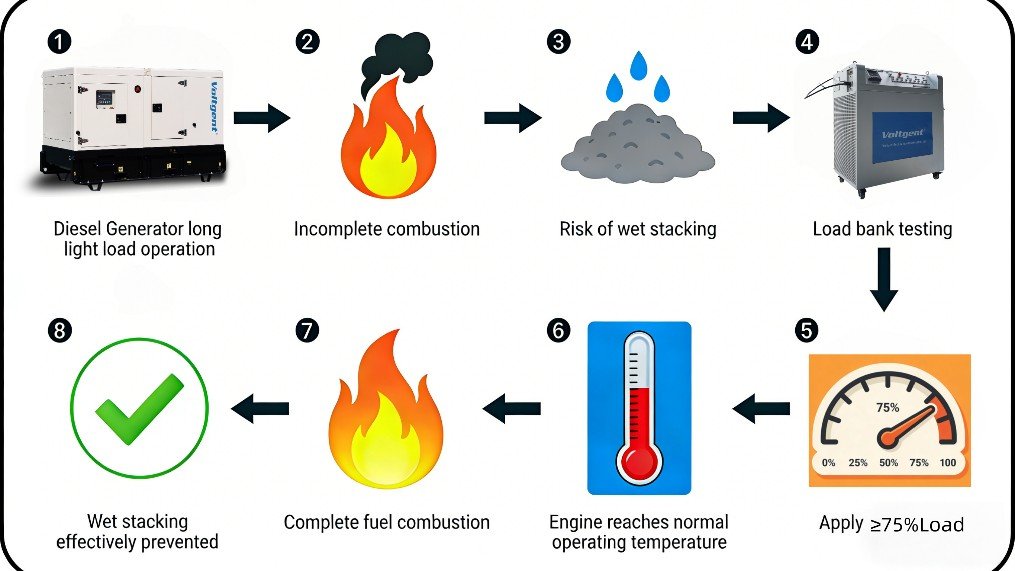
| Comparison Item | Comparison Item | Load Bank Testing |
| Engine temperature | Low | Normal |
| Fuel combustion | Incomplete | Complete |
| Wet stacking risk | Extremely high | Significantly reduced |
| Generator condition | Continual deterioration | Restored and maintained |
| NFPA compliance | Non-compliant | Compliant |
Industry Standards and Wet Stacking
NFPA 110 (Standard for Emergency and Standby Power Systems) clearly states:
- Generator testing should not be conducted long-term below 30% of rated load
- Low-load testing increases the risk of wet stacking
- Supplemental load bank testing should be used when necessary
This is why load bank testing has become “standard practice” in hospitals, data centers, and emergency power systems.
Conclusion: Load Bank Testing Is an Effective Measure to Prevent Wet Stacking
At its core, wet stacking results from prolonged low-load and low-temperature operation that leads to incomplete fuel combustion. Load bank testing provides a controlled and sufficient load, allowing the engine to reach its designed operating temperature, promoting complete fuel combustion, and effectively removing and preventing wet stacking.
When load bank testing is incorporated into a regular operation and maintenance program, it not only reduces wet stacking risk but also verifies the generator’s true performance under high-load conditions—ensuring reliable power delivery when it matters most.