

The value of a load bank lies not only in its ability to apply load, but in how accurately that load is applied.
This article provides a structured explanation of load bank calibration fundamentals, common misconceptions, and how Voltgent helps customers build a traceable and reliable testing system through robust design and testing capability.
What Is the Real Purpose of Load Bank Calibration?
Calibration is not simply about “eliminating alarms” or “zero adjustment.”
Its true objectives are to ensure that:
- Test data is repeatable
- Test results are traceable
- Test conclusions are accepted by third parties
This is especially critical for data center commissioning, EPC projects, and export equipment testing, where test data often serves as contractual or compliance evidence.
Standard Load Bank Calibration Process
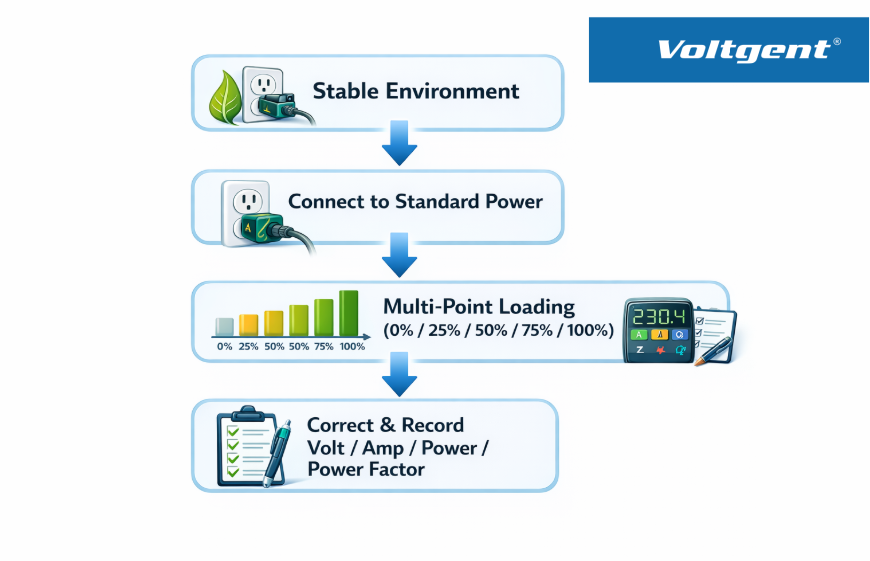
A proper load bank calibration process typically includes:
- Preparation of certified reference instruments
(Voltage, current, power, power factor, and harmonic analyzers) - Environmental condition stabilization
Ensure stable temperature and humidity during calibration - Multi-point load application
Calibration across 0–25–50–75–100% load levels - Comparison and error correction
Align measured values with reference standards - Documentation and traceability
Generate calibration records for audit and project acceptance
Key Load Bank Calibration Parameters
| Calibration Item | Key Focus | Engineering Significance |
| Voltage / Current | Full-scale accuracy control | Determines overall test credibility |
| Power | Consistency between output and display | Prevents “false full-load” results |
| Power Factor (PF) | Accuracy under low PF conditions | Simulates real-world load behavior |
| Harmonics (THD) | Non-linear load measurement | Reflects actual operating conditions |
Three Most Common Load Bank Calibration Mistakes
Mistake 1: Calibration = Zero Adjustment
Issue:
Only the zero point is calibrated, while full-load errors remain.
Correct Approach:
Multi-point calibration across the entire measurement range (0–100%) is mandatory.
Mistake 2: Ignoring Environmental Conditions
Issue:
Temperature and humidity variations affect measurement stability.
Best Practice:
Calibration should be performed under relatively stable environmental conditions.
Mistake 3: Calibration Without Records
Issue:
Results are not traceable and fail to meet project or audit requirements.
Best Practice:
All calibration data must be documented and retained for verification.
Voltgent Load Bank Calibration and Testing Value
Voltgent load banks are widely used in applications with high accuracy requirements, including:
- Generator factory acceptance testing
- UPS and data center commissioning
- Energy storage and renewable energy system testing
Key Advantages:
- Stable measurement architecture supporting long-term calibration consistency
- Accurate testing under multiple operating conditions, including low power factor
- Easy integration with third-party certified reference sources for calibration
Conclusion
Data without calibration is only “assumed to be correct.”
Only through standardized calibration procedures can a load bank become a truly reliable testing instrument.
For companies that value delivery quality, compliance, and brand credibility, load bank calibration is not a cost—it is a safeguard.