

Many non-electrical professionals assume that when purchasing or testing a Load Bank:
“As long as the load bank has enough kW capacity, it can complete the test.”
In reality, it is not that simple.
In an electrical power system, there are two fundamentally different types of power:
- Active Power (kW) – the power that performs useful work
- Reactive Power (kVAR) – the power required to support the operation of many electrical devices
Together, they determine:
- The actual operating condition of a generator
- Power factor (PF)
- AVR voltage regulation capability
- Excitation system performance
- Overall power system stability
This is why, in many industrial facilities, data centers, marine applications, and critical power projects, using only a Resistive Load Bank may not be enough to fully simulate real operating conditions.
This is where a Resistive Reactive Load Bank can provide a more realistic and comprehensive system test.
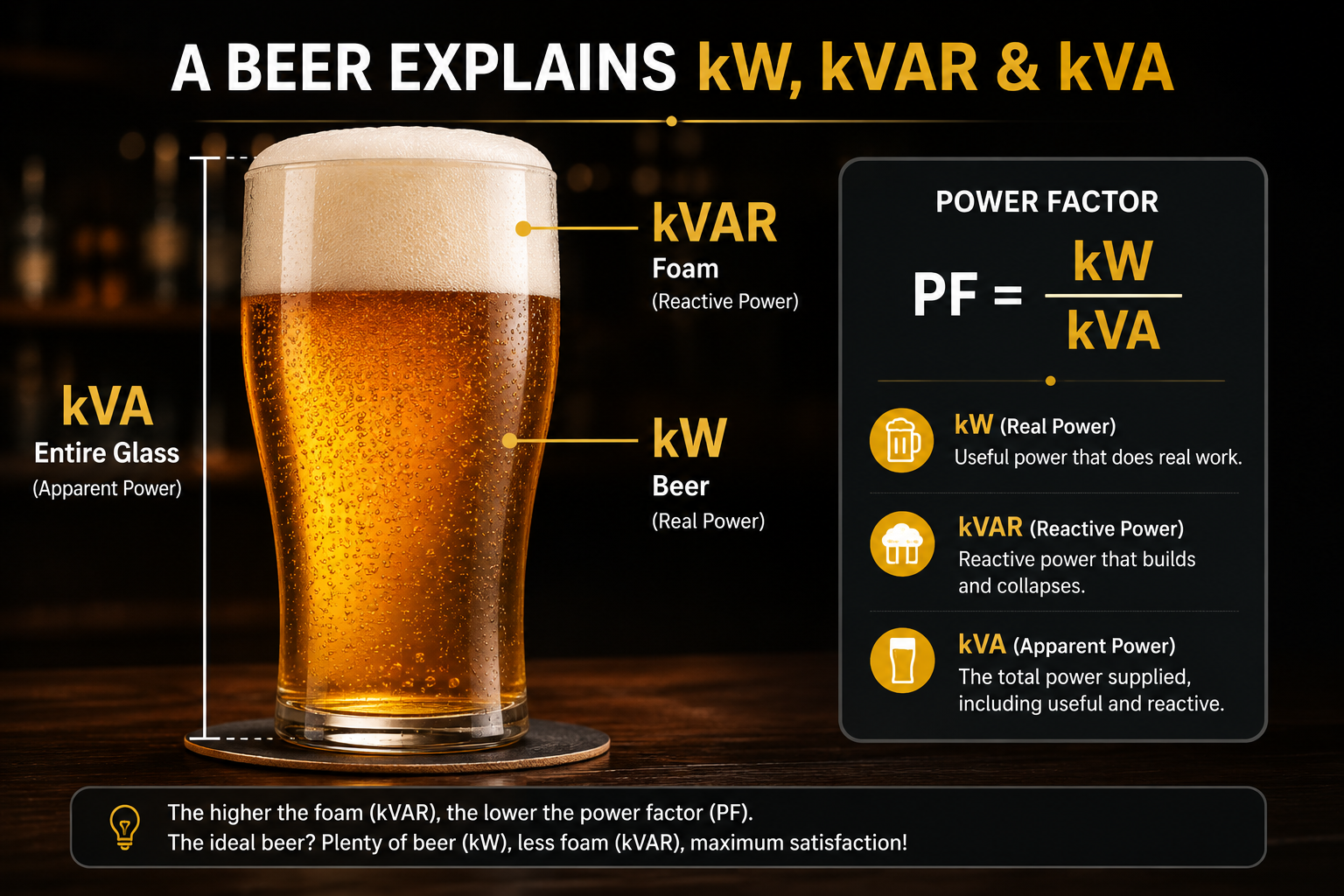
Understanding kW, kVAR and kVA with a Glass of Beer
One of the easiest ways to understand the relationship between kW, kVAR and kVA is to imagine a glass of beer.
| Beer Analogy | Electrical System | Meaning |
| Beer liquid | Active Power (kW) | The energy that actually performs useful work |
| Foam | Reactive Power (kVAR) | Does not perform useful work directly, but supports magnetic fields and the operation of electrical equipment |
| Entire glass | Apparent Power (kVA) | The total electrical capacity supplied by the power source |
In simple terms:
kW = The power that actually does the work
For example:
- Motors rotate
- Pumps operate
- Air-conditioning systems provide cooling
- Servers process data
- Heating elements generate heat
kVAR = The power that supports electrical equipment
Reactive power is particularly important for inductive equipment such as:
- Motors
- Transformers
- Compressors
- Pumps
- Large industrial machinery
It is associated with establishing and maintaining magnetic fields and supporting the operation of inductive loads.
kVA = The total capacity the generator must provide
This is why generator ratings are commonly expressed in kVA rather than only kW.
Why Do Many Projects Need a Resistive Reactive Load Bank?
A Resistive Reactive Load Bank combines resistive and reactive loading to create a more realistic electrical test environment.
| Test Method | Simulated Environment | Main Testing Capability |
| Resistive Load Bank | Simple resistive loads | Verify active power output and basic generator capacity |
| Resistive Reactive Load Bank | More realistic industrial electrical loads | Verify active/reactive power performance and voltage regulation |
| Actual Site Loads | Real operating environment | Most realistic, but often difficult to control and reproduce |
A resistive reactive load bank can simultaneously apply:
- kW active load
- kVAR reactive load
This allows engineers to evaluate more aspects of the power system, including:
- Generator output capability
- Voltage stability
- AVR response
- Excitation system performance
- Dynamic load response
How Should You Choose the Right Load Bank?
When purchasing a Load Bank, don’t focus only on kW capacity.
You should also consider the following parameters:
| Key Parameter | Why It Matters |
| Rated Power (kW) | Determines the active load testing capacity |
| Reactive Power (kVAR) | Determines the ability to simulate inductive loads |
| Power Factor (PF) | Determines how closely the test can replicate real operating conditions |
| Load Type | Resistive, reactive, or resistive-reactive |
| Voltage Rating | Must match the equipment under test |
| Frequency | Must match the generator or power system |
| Test Objective | FAT, SAT, commissioning, maintenance, or troubleshooting |
| Control & Monitoring | Determines how accurately the test can be controlled and recorded |
Voltgent Load Bank Testing Solutions
As a professional load testing equipment supplier, Voltgent provides load bank solutions designed for different generator and critical power applications.
Multiple Load Types
Voltgent supports:
- Resistive Load Banks
- Resistive Reactive Load Banks
- Customized Load Bank Solutions
Wide Power Range
Our solutions cover applications ranging from:
- 100 kW-class portable load banks
- Large MW-scale load testing systems
Designed for Critical Applications
Voltgent load banks can be used for:
- Generator FAT testing
- Generator commissioning
- Data center commissioning
- UPS testing
- Industrial power system verification
- Preventive maintenance
- Periodic generator testing
Reliable Test Performance
Our load bank systems are designed with:
- High-stability load elements
- Precise load control
- Reliable cooling and heat dissipation
- Electrical protection systems
- Data acquisition and monitoring
- Test data and report output
The objective is simple:
Provide more realistic test conditions and more reliable verification of critical power systems.
Conclusion: Don’t Just Look at kW — Look at the Load Type
The purpose of load testing is not simply to make a generator “produce power.”
A proper load test should also verify:
- Can the generator operate stably?
- Can it handle the required power factor?
- Can the AVR maintain stable voltage?
- Can the excitation system respond correctly?
- Can the generator handle realistic electrical conditions?
- Can the backup power system perform reliably when it is actually needed?
In simple terms:
kW represents the useful work being performed.
kVAR represents the reactive power required to support many electrical loads.
kVA represents the total apparent power capacity that the generator must handle.
For critical power systems, choosing the right load type can be just as important as choosing the right load capacity.
Voltgent is committed to providing professional and high-precision load testing solutions to help customers worldwide verify the real-world performance and reliability of generators, power systems, UPS systems, and critical infrastructure.