

Is a Standby Generator Really Safer When It Is Not Used Frequently?
Many companies have the following assumption:
“Our diesel generator only starts a few times a year and rarely operates, so the equipment should experience very little wear.”
It sounds reasonable, but the reality is different.
A diesel generator is not a piece of equipment that can simply be stored indefinitely without maintenance.
Even when operating in standby mode, its internal systems continue to change over time, including:
- Starting system
- Fuel system
- Lubrication system
- Cooling system
- Electrical control system
More importantly:
A generator that can start does not necessarily mean it can provide reliable power during an actual power outage.
True reliability must be verified through regular operation and load testing.
Why Is a Generator Like Human Muscle and Why Does It Need “Exercise”?
If a person stops exercising for a long period:
- Muscle strength decreases
- Cardiovascular ability declines
- The body cannot handle sudden physical demands
A diesel generator works in a similar way.
Long periods of inactivity or only short no-load runs can prevent the generator from maintaining optimal operating conditions.
For example:
Starting the generator and running it for only a few minutes can confirm:
✅ The engine can start
However, it cannot confirm:
❌ Whether it can continuously deliver rated power
❌ Whether it can handle load changes
❌ Whether the cooling system performs properly
❌ Whether voltage and frequency remain stable
Therefore:
A generator needs more than just starting. It needs to regularly operate under real working conditions.
What Hidden Risks Occur When a Generator Remains Idle for Too Long?
- Starting System Failure: The Generator May Not Start When It Is Needed Most
The primary purpose of a standby generator is to provide immediate power during a utility failure.
However, one of the most common problems caused by long periods of inactivity is:
The engine fails to start.
Battery Performance Degradation
Starting batteries naturally discharge even when they are not being used.
Without regular inspection:
- Battery capacity decreases
- Battery plates deteriorate
- Charging system problems may develop
This can result in:
The start command is received, but the engine cannot start.
Starting Components Remaining Unused
Components such as:
- Starter motors
- Relays
- Electrical connection points
may experience:
- Poor contact
- Corrosion
- Abnormal operation
For standby power systems:
A failed start means the entire backup power solution fails.
- The Fuel System Can Degrade Over Time
Many users assume:
“Diesel fuel stored in a tank should not have any problems.”
However, diesel fuel stored for long periods may experience:
- Oxidation
- Moisture accumulation
- Microbial growth
- Fuel sludge formation
These issues can affect:
- Fuel injection systems
- Combustion efficiency
- Engine performance
Fuel management becomes especially important in:
- High-temperature environments
- Humid environments
- Low-utilization applications
- The Engine Needs to Reach Normal Operating Conditions
A diesel engine does not immediately reach its optimal condition after startup.
It requires:
- Normal operating temperature
- Stable lubrication
- Complete thermal cycles
If a generator only operates as:
Start → Idle for a few minutes → Shutdown
it may not fully verify:
- Cooling capability
- Lubrication condition
- Load response capability
Simply put:
An engine needs exercise, not just occasional wake-up calls.
Why Can Startup Testing Not Prove Generator Reliability?
This is one of the most commonly overlooked issues among standby power users.
Many maintenance teams perform:
- Start the generator
- Observe operation
- Shut it down after a few minutes
However, this type of test only proves:
The generator can run.
It does not prove:
The generator can support real electrical loads.
There is a significant difference between the two.
| Test Item | No-Load Startup Test | Load Test |
| Engine startup | ✅ | ✅ |
| Rated power output | ❌ | ✅ |
| Voltage stability | ❌ | ✅ |
| Frequency control capability | ❌ | ✅ |
| Long-duration operation capability | ❌ | ✅ |
| Cooling system verification | ❌ | ✅ |
Therefore:
Being able to start does not mean being able to supply reliable power.
Load Testing: Keeping Standby Generators “Healthy”
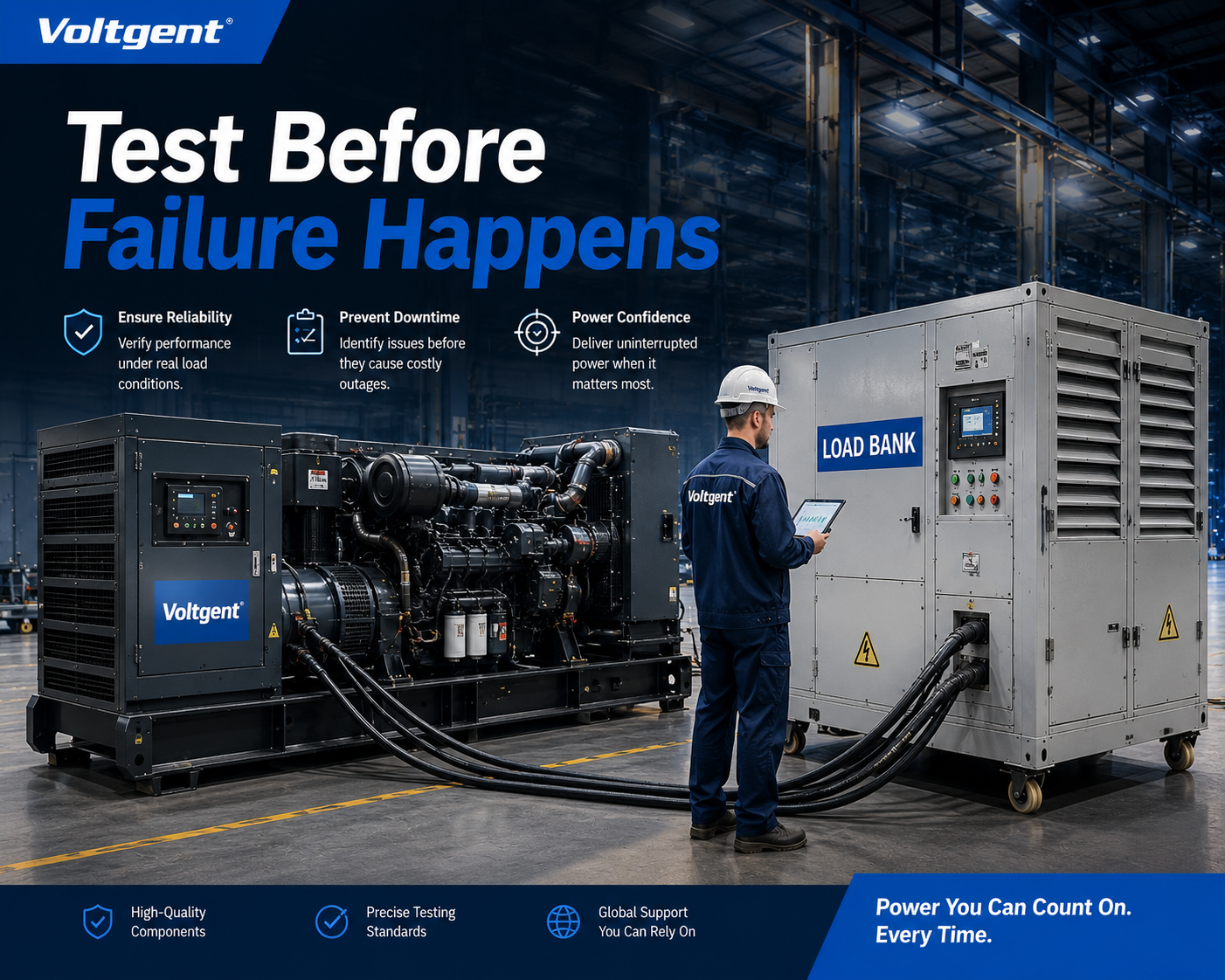
Generator Load Testing uses a Load Bank connected to the generator to simulate real electrical demand.
It can verify:
- Generator rated power output capability
- Engine load response
- Cooling system performance
- AVR voltage regulation capability
- Voltage and frequency stability
This is similar to giving a generator a complete fitness test.
Why Is a Load Bank Better Than Actual Loads for Maintenance Testing?
Many companies ask:
“Why can’t we simply connect the generator to our factory equipment for testing?”
The reason is that actual loads have limitations:
- Production equipment cannot always be stopped
- Load levels cannot be precisely controlled
- The same test conditions cannot easily be repeated
- There is a risk of affecting normal operations
A Load Bank provides:
| Actual Load | Load Bank |
| Uncontrolled | Precisely controlled |
| Difficult to repeat | Repeatable testing |
| May affect production | Independent testing |
| Difficult to standardize | Supports standardized test procedures |
Therefore:
A Load Bank transforms generator testing from simple observation into data-based verification.
How Often Should a Standby Generator Be Load Tested?
The testing frequency depends on:
- Application environment
- Risk level
- Industry requirements
- Generator type
For critical infrastructure, load testing is typically an important part of preventive maintenance programs.
Regular testing helps ensure that standby power systems remain ready when they are needed.
Voltgent Load Testing Solutions: Keeping Backup Power Reliable
As a professional load testing equipment supplier, Voltgent provides complete Load Bank testing solutions to help customers verify standby power system performance.
Voltgent solutions support:
- Generator load testing
- Performance verification
- Preventive maintenance testing
- Critical power system validation
Conclusion: A Standby Generator Is Not Safe Simply Because It Is Not Used
One of the biggest risks for a diesel generator is not excessive operation.
It is:
Long periods without proper verification.
The true reliability of a standby generator does not depend on whether it can start.
It depends on:
- Whether it can deliver stable power output
- Whether it has been tested under load conditions
- Whether it can perform when the system needs it most
Just as the human body needs exercise to stay strong, a diesel generator needs regular operation and testing to maintain reliability.
Through professional load testing, potential problems can be identified early, downtime risks can be reduced, and standby power systems can perform when they are truly needed.
Voltgent is committed to providing reliable and high-precision load testing solutions worldwide, helping every generator operate stably when reliability matters most.