

During generator testing, power system verification and data center commissioning, a Load Bank performs a critical function:
It simulates real electrical loads to verify the reliability and performance of power equipment.
When purchasing a Load Bank, many customers usually focus on:
- What is the rated power?
- What is the maximum capacity?
- What are the overall dimensions?
- What is the price?
But in reality, the core component that determines the long-term performance and testing accuracy of a Load Bank is not its enclosure.
It is the component hidden inside:
The Load Resistor System.
Simply put, the value of a Load Bank is not just its ability to “consume electrical power.”
Its real value lies in its ability to provide an accurate, stable and repeatable test load under prolonged high-temperature operating conditions.
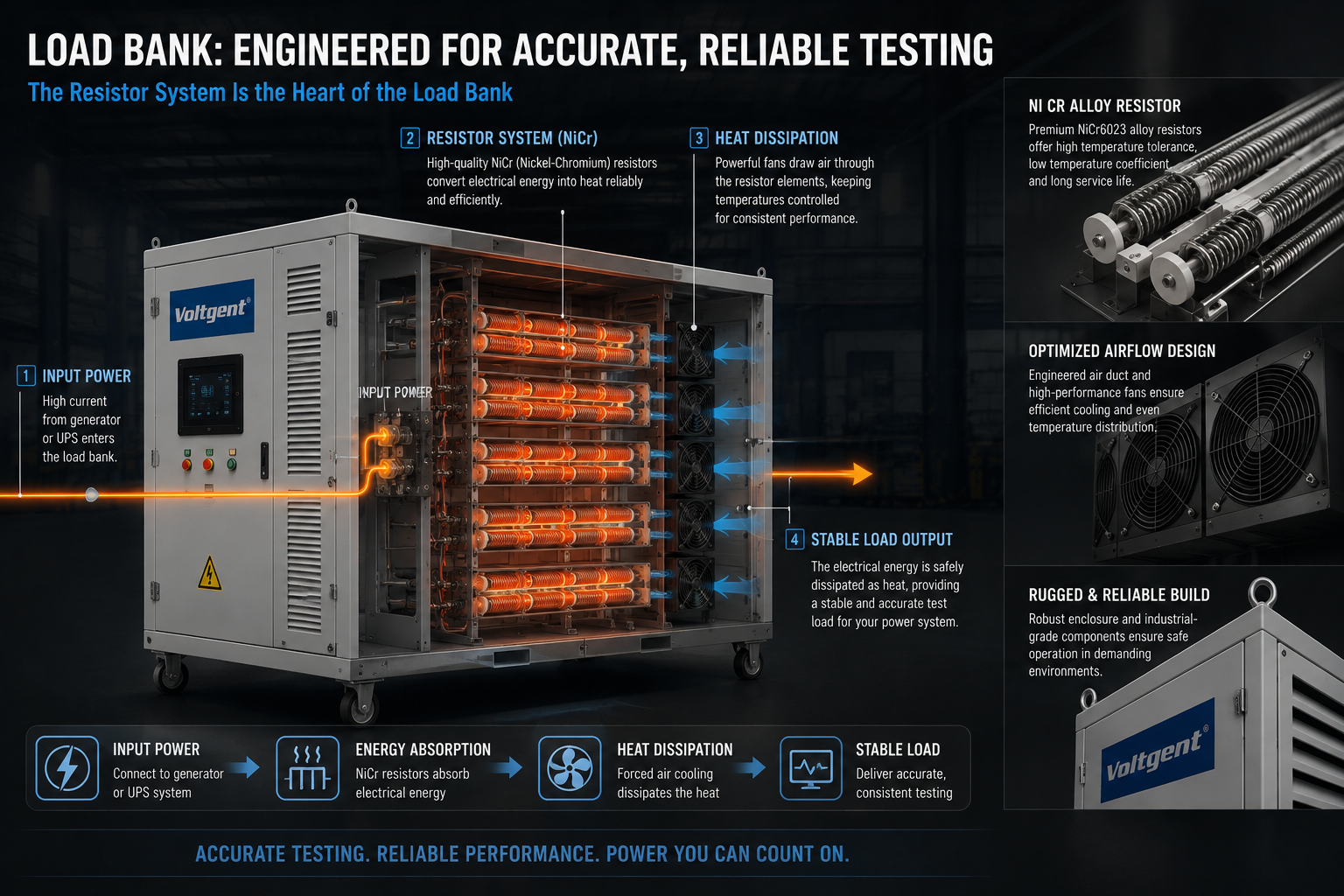
What Is a Load Bank and How Does It Work?
A Load Bank is a testing device designed to simulate actual electrical loads.
It uses internal resistor elements to convert electrical energy into heat, thereby simulating applications such as:
- Generator operation under load
- UPS output loading
- Data center critical power systems
- Actual electrical loads in industrial facilities
During testing, electrical current flows through the resistor elements:
Electrical Energy → Heat → Heat Dissipation
As a result, the resistor elements inside a Load Bank are exposed to:
- High current
- High temperatures
- Long periods of continuous operation
This means:
The performance of the resistor material directly affects the reliability of the test results.
Why Is Resistor Material So Important?
Many people assume:
“A 100 kW Load Bank simply produces a 100 kW load.”
In engineering applications, however, it is not quite that simple.
The resistance value of a resistor is not always constant.
When a resistor operates at high temperatures for extended periods, its electrical resistance can change. This characteristic is known as the:
Temperature Coefficient of Resistance (TCR)
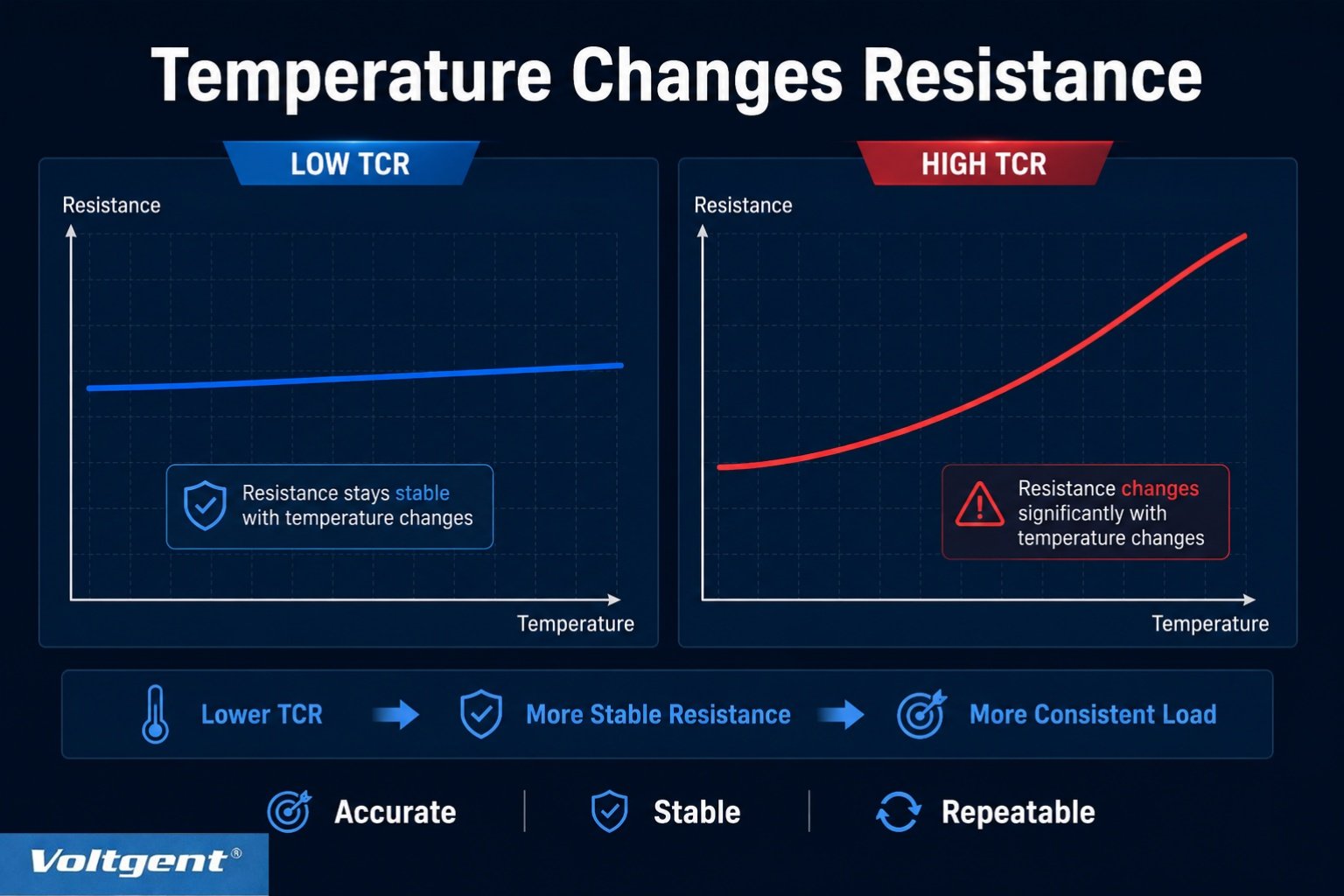
TCR describes how much the resistance value changes as the temperature changes.
In simple terms:
If the resistance changes significantly as the material heats up:
- Output power may change
- Test data may become less accurate
- Load stability may decrease
For generator testing, this can be important.
For example, a test may require verifying a generator’s 1,000 kW output capability.
If the resistance changes significantly due to temperature effects, the actual applied load may deviate from the intended test value.
The result?
The test may be completed, but the accuracy and consistency of the test data may be compromised.
Standard Resistor Materials vs. High-Performance Load Resistor Materials
Different resistor materials can behave very differently during prolonged high-temperature operation.
| Comparison | Standard Metal Resistor Materials | High-Performance Load Resistor Materials |
| High-Temperature Stability | More affected by temperature changes | Stable at high temperatures |
| Resistance Change | Greater resistance drift | Lower TCR and smaller resistance variation |
| Continuous Operation | Performance may degrade during prolonged operation | Designed for sustained high-load operation |
| Test Accuracy | Greater potential for measurement deviation | More stable output |
| Service Life | More affected by thermal fatigue | Longer operating life |
For this reason, high-quality Load Banks commonly use materials such as:
- Nickel-Chromium Alloys
- Stainless Steel Grid Resistors
as their core heating/resistor elements.
Why Is Nickel-Chromium Alloy Commonly Used in Load Banks?
Nickel-Chromium Alloy has long been used in high-temperature resistance applications.
There are several reasons for this.
- Excellent High-Temperature Stability
During load testing, resistor elements may continuously operate at temperatures of several hundred degrees Celsius or even higher.
Nickel-chromium alloys can maintain relatively stable resistance characteristics under high-temperature conditions.
This helps keep the applied load closer to the designed test value.
- Good Oxidation Resistance
At high temperatures, ordinary metals can be more susceptible to:
- Oxidation
- Performance degradation
- Reduced service life
Nickel-chromium materials offer good resistance to high-temperature oxidation, helping improve long-term operating reliability.
- Suitable for High-Power Continuous Testing
Data centers, generator manufacturers and industrial projects often require staged loading such as:
25% → 50% → 75% → 100%
Some tests may also require several hours of continuous operation.
Therefore, load resistor elements need to maintain stable performance during prolonged high-power operation.
Why Can Low-Cost Load Banks Affect Test Results?
There can be significant price differences between Load Banks on the market.
In addition to brand, control systems and mechanical design, the resistor material and thermal design are also important cost factors.
Lower-cost solutions may reduce costs by:
- Using lower-grade materials
- Simplifying the cooling and heat dissipation design
- Reducing the design margin of resistor elements
During short-duration testing, these differences may not be immediately obvious.
However, under:
- Long-duration testing
- Full-load testing
- High-temperature environments
- Continuous operation
the differences can become increasingly apparent.
Potential consequences include:
❌ Load output degradation
❌ Resistance variation caused by temperature
❌ Test data deviation
❌ Reduced equipment service life
What Should a Good Load Bank Be Able to Provide?
A reliable Load Bank should do more than simply achieve its rated kW capacity.
It should also provide:
| Core Requirement | Purpose |
| Stable Resistance Characteristics | Maintain test accuracy |
| Effective Heat Dissipation Design | Support continuous operation |
| High-Quality Insulation | Improve electrical safety |
| Precise Load Control | Enable repeatable testing |
| Data Recording Capability | Support analysis and acceptance testing |
For critical industries such as:
- Data centers
- Hospitals
- Industrial facilities
- Power infrastructure
the reliability of test data is directly related to the safety and reliability of the overall power system.
Voltgent Load Banks: Reliability from Material to System Design
As a professional load testing solution provider, Voltgent focuses not only on load capacity, but also on the overall stability and performance of the testing system.
Voltgent Load Banks feature:
- High-stability resistor material design
- Optimized heat dissipation
- Precise load control systems
- Resistive, reactive and resistive-reactive load testing
- Applications from 100 kW to MW-class systems
- Comprehensive test data recording
Typical applications include:
- Generator Factory Acceptance Testing (FAT)
- Site Acceptance Testing (SAT)
- Data center power system verification
- Industrial power system maintenance
Voltgent is committed to helping customers move from:
“The equipment can operate”
to:
“The equipment has been tested and verified to operate reliably.”
Conclusion
A Load Bank is not simply a “heating device.”
It is a precision testing system designed to verify the reliability of electrical power systems.
What truly determines test quality is often hidden inside the equipment:
Resistor material, thermal stability and long-term operating capability.
A good Load Bank does more than provide a power rating.
Throughout the entire test process, it should continuously deliver:
- Accurate
- Stable
- Repeatable
test results.
This is why Voltgent continues to focus on load testing technology, resistor performance and engineering quality.
FAQ
Q1: Why Does a Load Bank Need Resistors?
A Load Bank uses resistor elements to simulate real electrical loads by converting electrical energy into heat.
This allows engineers to test the performance of generators, UPS systems and other power equipment under controlled load conditions.
Q2: Why Do Load Banks Have Such Different Prices?
The major differences can come from:
- Resistor materials
- Heat dissipation design
- Control systems
- Manufacturing processes
- Safety and protection systems
Among these factors, the resistor system has a direct impact on long-term load stability and testing performance.
Q3: What Is TCR?
TCR (Temperature Coefficient of Resistance) is a parameter that describes how much the resistance value changes as temperature changes.
In general, a lower TCR means that the resistance is less sensitive to temperature changes, helping maintain more stable load characteristics.
Q4: Why Is Nickel-Chromium Alloy Suitable for Load Banks?
Nickel-chromium alloys offer good high-temperature stability, oxidation resistance and long-term operating reliability, making them suitable for high-power and continuous load testing applications.