

-
Why Does a Load Bank Need to “Breathe”?
When a Load Bank rated at several hundred kilowatts or even several megawatts is operating, one of the most obvious things you will notice is:
The fans are working hard.
Customers who are new to Load Banks may wonder:
“Isn’t it just a resistive load? Why does it need such powerful fans?”
The answer is actually quite simple.
A Load Bank is essentially a giant electric heater.
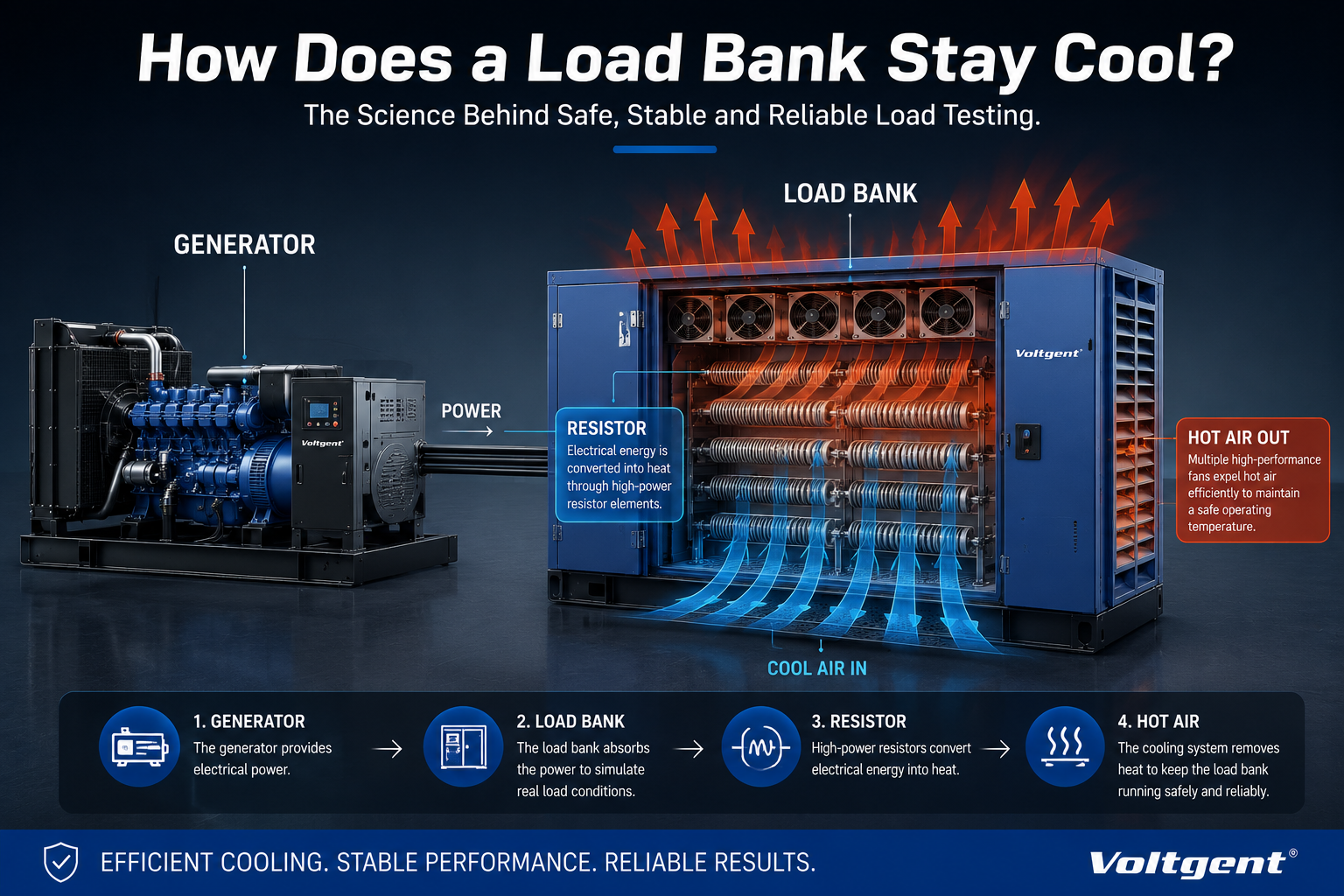
When a generator supplies electrical power to a Load Bank, the resistor elements convert electrical energy into heat.
For example:
A 1 MW Load Bank operating for 1 hour generates approximately 1,000 kWh of thermal energy.
That heat must be continuously removed.
Otherwise:
Resistor temperature keeps rising → Material characteristics change → Load capacity decreases → Component damage may occur
So, for a Load Bank:
The resistor generates the heat, while the fan removes it.
This is why Load Bank airflow design is a critical part of Load Bank reliability.
-
Think of a Load Bank Like a Person Running on a Hot Summer Day
A very simple analogy can help explain this.
When you run on a hot summer day, your body continuously generates heat.
If you run in a room without airflow:
The hotter you become.
But if a fan continuously blows air over you:
The heat is removed more effectively.
A Load Bank works in much the same way.
Inside a Load Bank:
Resistor elements = The person continuously generating heat
Cooling fans = The electric fan
Airflow = The process that carries heat away
Therefore:
A Load Bank does not simply need “more airflow.” It needs sufficient and properly directed airflow.
-
What Is the Difference Between Airflow and Static Pressure?
These are two of the most important concepts in a Load Bank cooling system.
- Airflow
Airflow refers to:
The amount of air passing through the Load Bank within a given period of time.
It is commonly measured in:
- CFM
- m³/h
Simply put:
Airflow = How much air can be moved?
For MW-class Load Banks, large volumes of air must continuously pass through the resistor elements to remove the heat generated during testing.
- Static Pressure
However, high airflow alone is not enough.
Inside a Load Bank, air must pass through:
- Resistor elements
- Protective grilles
- Air guides
- Air ducts
- Air outlets
All of these components create resistance to airflow.
Therefore, the fan must not only provide sufficient airflow, but also generate enough pressure to overcome the resistance of the entire airflow system.
Simply put:
Airflow determines how much air is moved, while static pressure determines whether the air can actually move through the system.
A water pipe provides a simple analogy:
Airflow ≈ Water flow rate
Static pressure ≈ Water pressure
If a pipe is blocked or heavily restricted, even a powerful pump may not be able to deliver sufficient actual flow.
The airflow system of a Load Bank works in much the same way.
-
Why Is Incorrect Airflow Direction More Dangerous Than Insufficient Air Velocity?
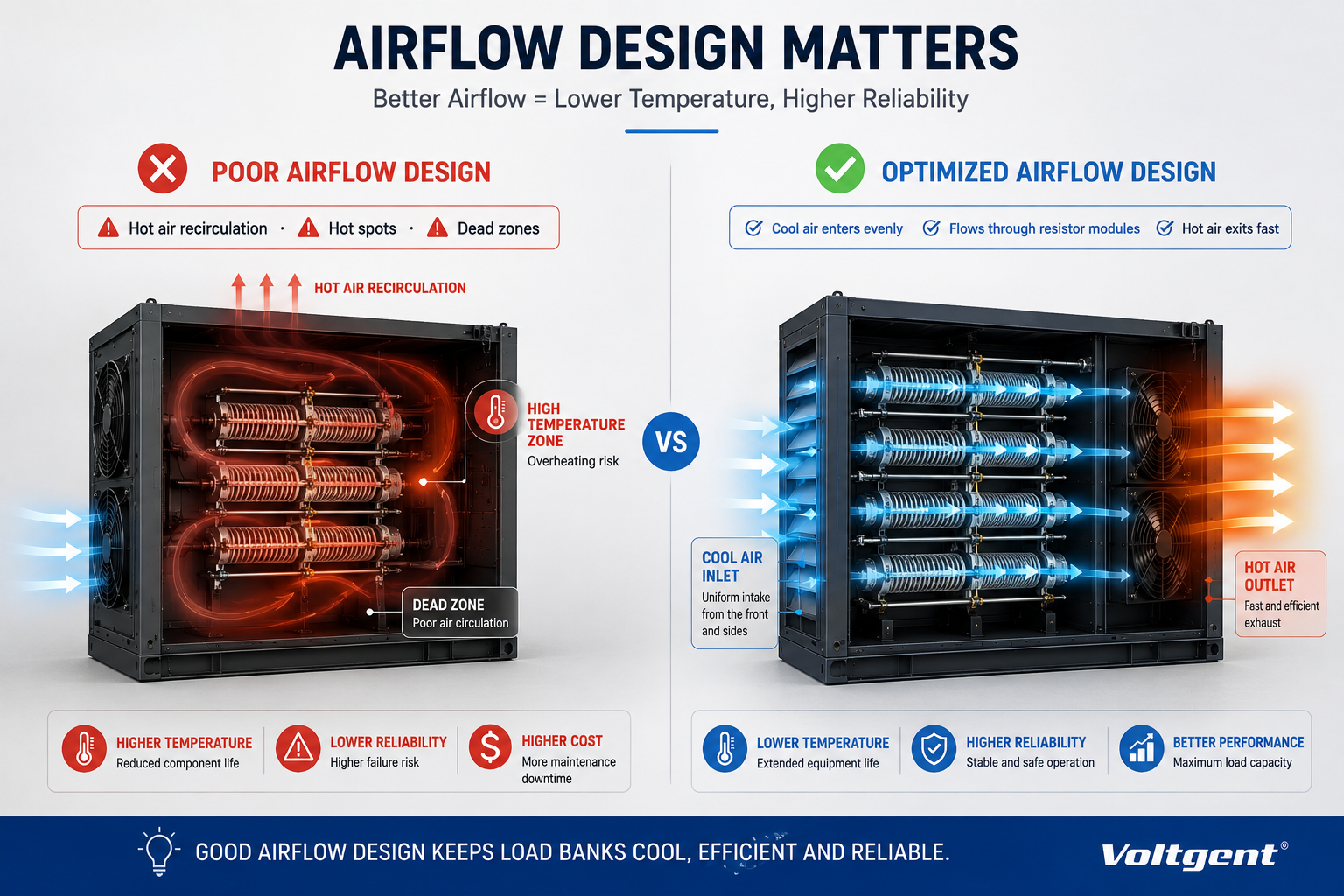
This is a critical consideration in Load Bank design.
The airflow inside a Load Bank must follow the designed path:
Cool air enters
↓
Passes through the resistor elements
↓
Absorbs heat
↓
Hot air is discharged
If the airflow direction is incorrect:
Hot air may not be discharged properly.
As a result, heat can accumulate inside the equipment.
Therefore, the cooling system of a Load Bank is not simply a matter of:
“Install a large fan and the problem is solved.”
A proper cooling design needs to consider:
- Fan rotation and airflow direction
- Airflow volume
- Static pressure
- Air inlet area
- Air outlet area
- Air duct resistance
- Resistor element arrangement
- Hot-air discharge path
This is what Load Bank Airflow Design is really about.
-
Why Does Insufficient Fan Speed Affect Load Bank Performance?
Actual fan performance depends on many factors.
If a fan does not operate at its designed working condition, for example due to:
- Insufficient fan speed
- Insufficient motor power
- Power supply abnormalities
- Fan impeller problems
- Excessive airflow resistance
the actual airflow will decrease.
And lower airflow means:
Reduced heat dissipation capacity.
As the Load Bank continues operating:
Resistor temperature ↑
↓
Internal equipment temperature ↑
↓
Resistance value changes
↓
Load output may change
↓
Over-temperature protection may activate
↓
In severe cases, resistor elements may be damaged
Therefore:
The cooling system of a Load Bank affects not only equipment life, but also test accuracy.
-
Why Can’t Resistor Elements Simply Be “Cooked”?
The resistor elements inside a Load Bank are normally designed to operate within a specific temperature range.
Excessive temperature can result in:
- Resistance value changes
- Material aging
- Mechanical deformation
- Thermal stress on insulation components
- Reduced component life
This becomes especially important during long-duration testing.
For example:
1,000 kW × 4 hours
The equipment must continuously handle a tremendous amount of thermal energy.
At this point:
Heat dissipation capacity determines whether the Load Bank can actually withstand the test.
Therefore, a professional Load Bank should calculate and optimize the entire thermal management chain during the design stage:
Heat generation → Airflow → Static pressure → Air duct → Outlet air temperature
Rather than simply adding a fan after the equipment has already been built.
-
Why Are Large Load Banks Paying Increasing Attention to Air Duct Design?
The higher the power:
The greater the amount of heat generated.
For example:
100 kW
↓
500 kW
↓
1 MW
↓
2 MW
↓
5 MW
As power increases, the requirements for the cooling system also increase significantly.
Especially for MW-class Load Banks, the system may require:
- Multiple-fan configurations
- Optimized air inlet structures
- Independent airflow paths
- Large-area air outlets
- Isolation of high-temperature zones
- Temperature sensors
- Fan failure protection
Over-temperature protection
This is why:
An MW-class Load Bank is not simply a 100 kW Load Bank made ten times larger.
The higher the power, the greater the requirements for overall system engineering and thermal management.
-
What Should a Good Load Bank Cooling System Provide?
When purchasing a Load Bank, it is not enough to ask:
“What is the rated power of your Load Bank?”
You should also ask:
“How have you solved the heat dissipation problem?”
The following aspects deserve particular attention:
| Key Design | What to Consider |
| Airflow | Is it sufficient for the cooling requirements of the resistor elements? |
| Static Pressure | Can the fan overcome the resistance of the internal airflow system? |
| Airflow Direction | Does it ensure that cool air effectively passes through the heat-generating areas? |
| Air Duct Design | Are there obvious airflow dead zones? |
| Fans | Are the motor power, reliability, and protection systems adequate? |
| Temperature Monitoring | Can the temperature at critical locations be monitored in real time? |
| Protection System | Does the system provide over-temperature and fan-failure protection? |
A truly professional Load Bank is a combination of:
Electrical engineering + Thermal management engineering.
-
Why Does Thermal Design Ultimately Affect Test Accuracy?
This is particularly important for professional Load Bank buyers.
Suppose a Load Bank has a rated capacity of: 1,000 kW
In theory, the customer expects it to provide a stable: 1,000 kW load
However, as operating time increases, if the resistor element temperature continues to rise:
The resistance value may change.
This means:
The actual load power may also change.
In other words:
The thermal stability of the Load Bank directly affects the stability of the test conditions.
This is particularly important for:
- Generator FAT
- Generator SAT
- UPS Testing
- Data Center Commissioning
- Long-duration endurance testing
Stable and repeatable test conditions are critical in all of these applications.
-
How Does Voltgent Solve the “Heat Dissipation” Challenge?
For Voltgent, Load Bank design is not simply about:
“Putting resistor elements inside a box.”
Instead, the entire system is designed as an integrated solution:
Resistor Elements → Fans → Airflow Path → Temperature Monitoring → Protection System
Voltgent Load Bank solutions can cover:
- 100 kW-class applications
- 500 kW-class applications
- 1 MW-class applications
- Large MW-class testing projects
Depending on project requirements, Voltgent can provide:
Resistive Load Banks
as well as:
Resistive Reactive Load Banks
for applications including:
- Generator testing
- UPS testing
- Data center commissioning
- FAT / SAT
- Industrial power system testing
For high-power projects, Voltgent focuses on:
Stable Loading + Efficient Cooling + Safety Protection + Continuous Operation
Conclusion: The Real Core Competitiveness of a Load Bank Is More Than How Many kW It Can Handle
Whether a Load Bank can complete a test does not depend only on:
“Can it load 1,000 kW?”
It also depends on:
“Can it continuously and stably load 1,000 kW while effectively removing the heat generated?”
This is why:
Load Bank Airflow Design is not an auxiliary feature. It is a critical factor in determining Load Bank reliability.
For high-power and long-duration load testing:
- Good resistor materials are responsible for withstanding high temperatures.
- Good fans provide sufficient airflow.
- Good air duct design ensures that the air moves in the right direction.
All three are essential.
Voltgent is committed to providing stable, efficient, and reliable load testing solutions through high-quality resistor elements, optimized airflow design, and comprehensive temperature protection.
Our goal is to help customers around the world perform high-power testing that is safer, more accurate, and more reliable.