

In the past, load bank testing relied heavily on manual operation. Test engineers would stand in front of the control panel and manually connect or disconnect load steps as required.
Today, as the scale of testing for diesel generators, UPS systems, data centers, and large power systems continues to increase, load bank control technology has also evolved significantly — from simple manual switches to digital control, PLC-based automatic loading, remote monitoring, and automated test sequences.
So, how does a modern load bank actually become “smarter”?
Simply put:
In the past, people controlled the load bank. Today, the control system can control the load bank according to a predefined test program.
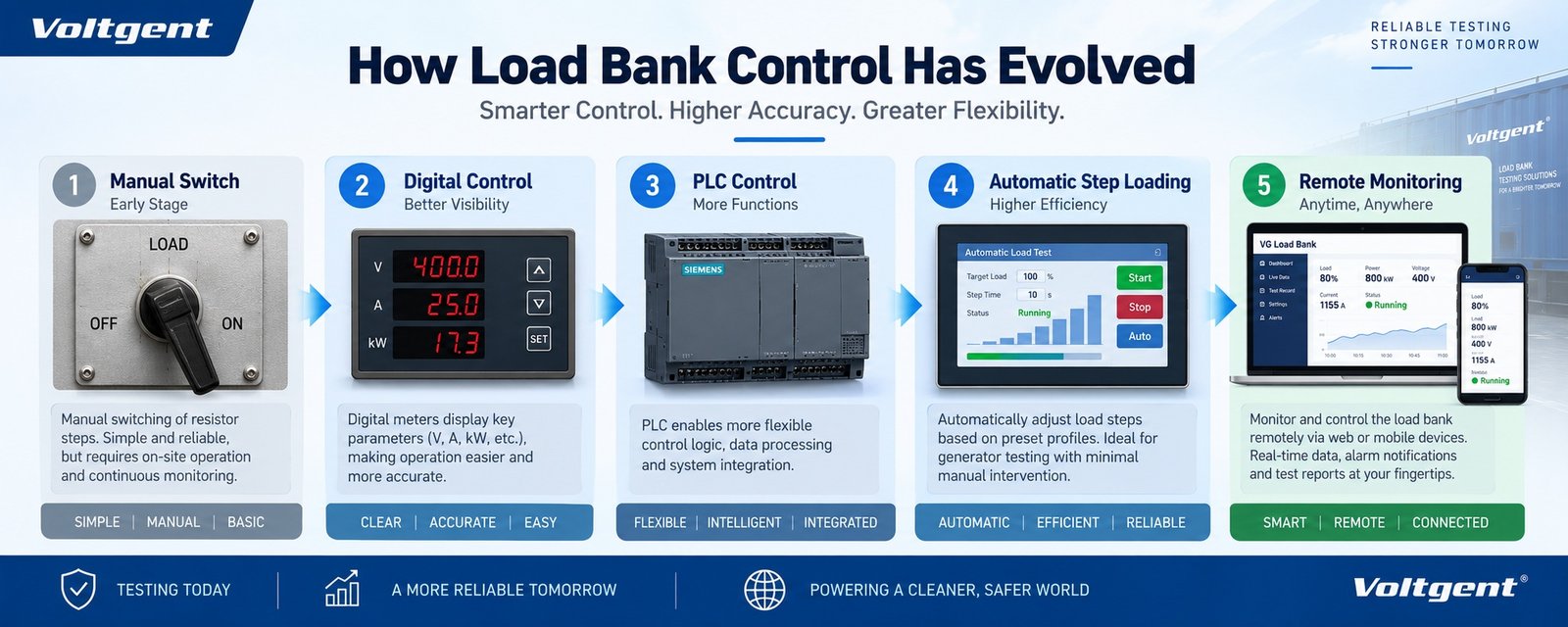
-
The “Intelligence” of a Load Bank Starts with Load Control
The basic operating principle of a load bank has not changed.
It still works by connecting different load units so that a generator or other power source operates under different electrical loads.
For example, a 1,000 kW load bank may consist of multiple load units with different power ratings.
Test engineers can combine these load units as required:
100 kW → 200 kW → 300 kW → 500 kW → 800 kW → 1,000 kW
This is known as Load Step.
The difference is in how these load steps are controlled:
- Traditional equipment mainly relies on operators to manually select each load step.
- Modern systems can use digital controllers or PLCs to execute load steps automatically.
- More advanced systems can execute an entire test sequence automatically according to predefined parameters.
Modern load bank control systems can now support automatic test sequences, real-time data acquisition, and remote operation.
-
Manual Control: Simple and Straightforward
Traditional load banks typically use manual control.
Operators select the required load through switches or buttons on the control panel.
For example:
Need to test at 600 kW?
The operator may manually connect:
100 kW + 100 kW + 200 kW + 200 kW = 600 kW
The biggest advantage of manual control is:
It is simple, direct, and easy to understand.
For small generator tests, maintenance testing, and occasional field testing, manual control can still be highly practical.
Some traditional load banks use mechanical or electrical switches to combine different load steps. Modern manual control panels may also incorporate digital displays and electronic controls to improve operating convenience.
But there are obvious limitations.
As load banks reach several hundred kilowatts or even several megawatts, relying entirely on manual operation becomes increasingly complicated.
This is especially true when testing requires:
- Multiple load steps
- Long-duration testing
- Repeated test cycles
- Multiple load banks operating in parallel
Manual operation can easily result in:
Incorrect operating sequences, inconsistent loading times, and difficulty reproducing the same test conditions.
As a result, automatic control has gradually become an important development direction for large-scale load testing.
-
Automatic Step Loading: Let the Load Bank Follow a Test Program
One of the most important functions of an automated load bank is Automatic Step Loading.
This means that the load bank automatically increases or decreases the load according to a predefined test sequence.
For example, suppose a 1,000 kW generator needs to be tested.
The test program can be configured as follows:
| Test Stage | Target Load | Duration |
| Step 1 | 25% / 250 kW | 10 min |
| Step 2 | 50% / 500 kW | 10 min |
| Step 3 | 75% / 750 kW | 10 min |
| Step 4 | 100% / 1,000 kW | 30 min |
Once the program has been configured, the control system can automatically connect and disconnect the load according to the predefined sequence.
This means that test engineers do not need to remain next to the load bank continuously operating switches.
Modern load bank control systems can support features such as:
- Automatic test cycles
- Programmable load steps
- Configurable duration for each step
- Test data recording
-
What Is a PLC and Why Does a Load Bank Need One?
This brings us to the PLC (Programmable Logic Controller).
There is no need to think of a PLC as something overly complicated.
Simply put:
The PLC is the “brain” of the load bank.
It receives commands from the operator and determines:
When should the load be connected?
How much load should be applied?
When should the test stop?
When should the load be disconnected because of an abnormal condition?
For example:
Start the cooling fans → confirm that cooling is normal → apply 250 kW → wait 10 minutes → increase to 500 kW → increase to 750 kW → finally reach 1,000 kW.
These actions can be executed automatically by the PLC according to predefined control logic.
Modern load banks widely use PLCs, touchscreens, and digital control systems to achieve precise load management and automated testing.
-
The Real Value of Automation Is Not “Automatic” — It Is Repeatability
The biggest advantage of automatic control is not simply that operators have to press fewer buttons.
The real value is:
Making the test repeatable.
Suppose the same generator is tested today and again tomorrow.
With completely manual operation, the first test might be:
250 kW → 500 kW → 750 kW → 1,000 kW
while the second test might be:
200 kW → 500 kW → 800 kW → 1,000 kW
The duration of each step may also be different.
In this situation, it becomes difficult to make a strict comparison between the two test results.
With automated testing, the test procedure can be standardized:
Same Load Steps + Same Duration + Same Test Sequence
This makes it possible to accurately compare:
- Voltage changes
- Frequency changes
- Current changes
- Temperature changes
- Power changes
- System response
This is particularly important for FAT, SAT, and periodic maintenance testing.
-
Modern Load Banks Can Also “Read” the Data
The development of control systems has changed not only how loads are applied, but also how test results are recorded.
Modern load banks can monitor and display parameters such as:
- Voltage
- Current
- Frequency
- kW
- kVA
- Power Factor
- Temperature
- Load Step
Some systems also support data export and automatic test report generation.
This means testing is no longer simply:
“We ran the generator at 1,000 kW today.”
Instead, it can become:
“At 250, 500, 750, and 1,000 kW, how did the voltage, frequency, and other key parameters perform at each load level?”
In other words:
Load testing is evolving from simply “performing a test” to “creating documented test evidence.”
-
Taking It Further: Remote Control and Multiple Load Banks Working Together
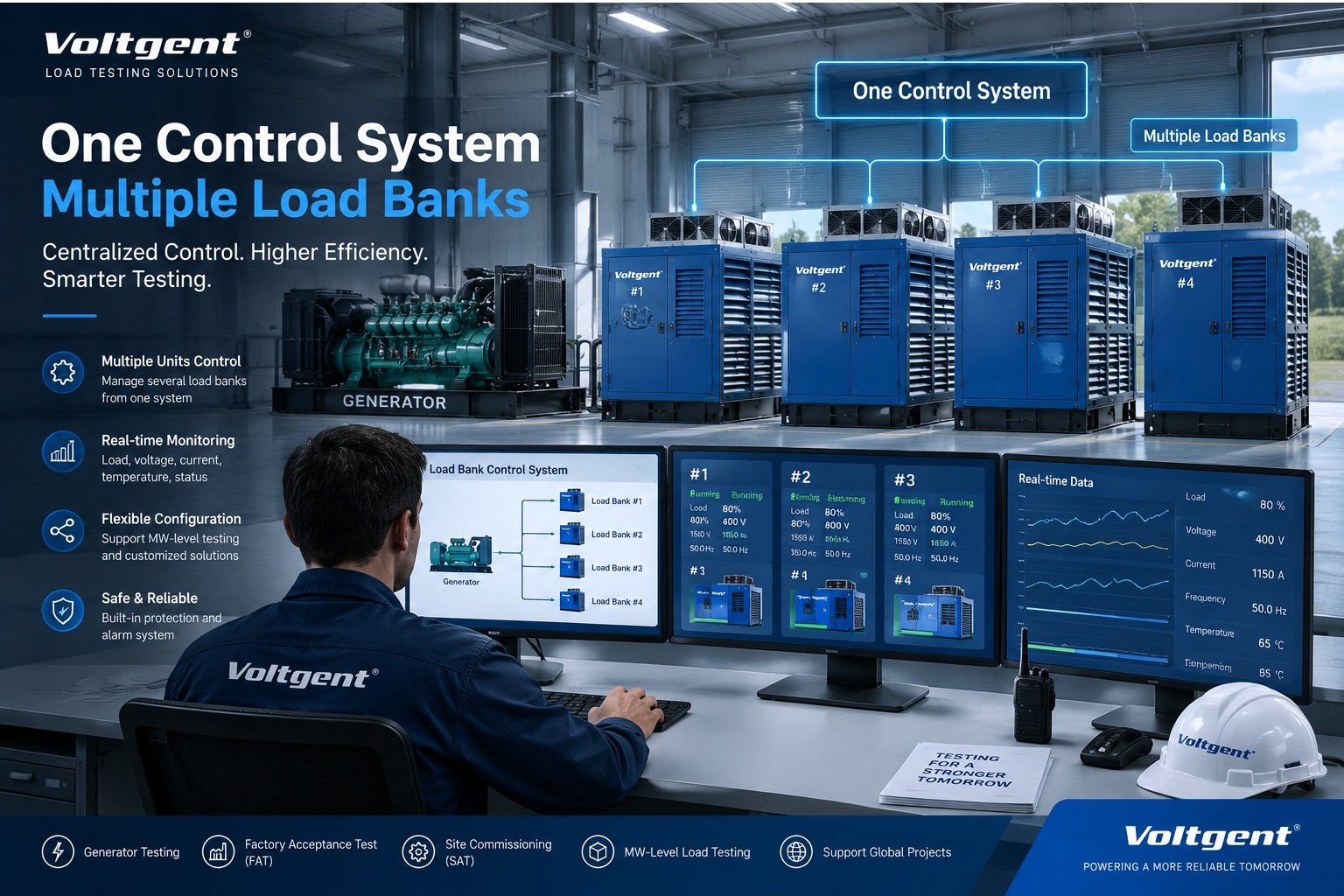
When testing reaches the scale of data centers, large generators, or MW-level projects, a single load bank may no longer be sufficient.
The system may require:
Multiple Load Banks + Control System + Communication Network
Modern load bank control platforms can communicate with other systems through interfaces such as:
- Ethernet
- RS-485
- Modbus
They can also support remote operation and fault diagnosis.
For example:
1 MW + 1 MW + 1 MW = 3 MW
Three load banks can be controlled as a unified system.
Operators can monitor the entire test system from a central control room rather than standing next to each individual load bank.
This centralized control approach is particularly valuable for:
- Data center commissioning
- Large generator testing
- MW-level power system testing
-
Manual vs. Automatic Control: Which One Should You Choose?
This does not mean:
Automatic control is always better than manual control.
The right choice depends on the actual testing requirements.
| Comparison | Manual Control | Automatic Control |
| Operation | Manual load selection | PLC / digital system control |
| Small-scale testing | ✅ Suitable | ✅ Suitable |
| Large-scale testing | ⚠️ More complicated | ✅ Recommended |
| Repeated testing | ⚠️ Operator dependent | ✅ Highly repeatable |
| Automatic test programs | ❌ | ✅ |
| Data recording | Basic | ✅ Expandable |
| Remote control | Usually limited | ✅ |
| Multiple load banks | More complicated | ✅ More suitable |
| Cost | Lower | Usually higher |
Simply put:
Small, simple, occasional testing → Manual control may be sufficient.
Large, complex, highly repetitive testing → Automatic control offers greater advantages.
-
Load Bank “Intelligence” Is Not About Showing Off Technology
For a load bank, the control system should ultimately serve one purpose:
Making testing safer, more accurate, repeatable, and traceable.
For example, in some load bank systems, the control logic can work together with cooling fans, over-temperature protection, and other safety interlocks.
If the cooling system fails, the control system can prevent further loading or initiate a protective action.
Modern load bank systems can incorporate safety logic such as fan failure protection and over-temperature protection.
Therefore:
A truly well-designed load bank control system should not only know how to load — it should also know when loading is permitted and when loading must stop.
-
Voltgent: Moving Load Testing from Manual Operation to Controlled Testing
As testing requirements for generators, UPS systems, data centers, and large power systems continue to increase, a load bank is no longer simply a “resistor box.”
Voltgent focuses not only on load capacity, but also on:
- Precise Load Step control
- Digital control systems
- Automatic test programs
- Real-time parameter monitoring
- Test data recording
- Multi-unit system expansion
- FAT / SAT and field testing applications
From manual control to automatic step loading, and then to PLC control, remote monitoring, and data recording, load banks are evolving from simple testing equipment into more complete power testing systems.
For customers, the ultimate goal is not to make a load bank “look smarter.”
It is to:
Make every test more accurate, controllable, repeatable, and supported by reliable test data.
That is the real value of modern load testing.
FAQ
-
What is Automatic Step Loading?
Automatic Step Loading is a function that allows a load bank to automatically increase or decrease the load according to a predefined test program, without requiring an operator to manually switch each load step.
-
What is the role of a PLC in a load bank?
A PLC can be understood as the control “brain” of the load bank. It executes loading programs, controls load steps, and coordinates protection, monitoring, and other control functions.
-
Is an automatic load bank always better than a manual load bank?
Not necessarily.
For small generator maintenance and simple field testing, manual control may already be sufficient. For large generators, data centers, and highly repetitive testing, automatic control is generally more efficient and consistent.
-
What are the advantages of automatic load testing?
The biggest advantages are repeatability and traceability.
The same test program can be executed repeatedly, while real-time data recording makes it easier to compare test results over time.
-
Can a load bank be controlled remotely?
Yes.
Some modern load banks support communication interfaces such as Ethernet, RS-485, and Modbus, as well as PC-based software. Depending on project requirements, these systems can support remote operation, data monitoring, and integration with other control systems.