

A UPS battery system showing 100%—does that mean it can still perform like a new battery?
Not necessarily.
Just like a smartphone can still show 100% when fully charged after several years of use, its actual battery life may have become significantly shorter. Industrial batteries can experience a similar decline.
For UPS systems, data centers, telecommunications systems, and industrial backup power applications, the more important question is not:
“Is the battery fully charged?”
but:
“Under specified load conditions, how much capacity can the battery actually deliver?”
This is exactly what a Battery Capacity Discharge Test is designed to determine.
And one of the key pieces of equipment used during this process is a:
DC Load Bank.
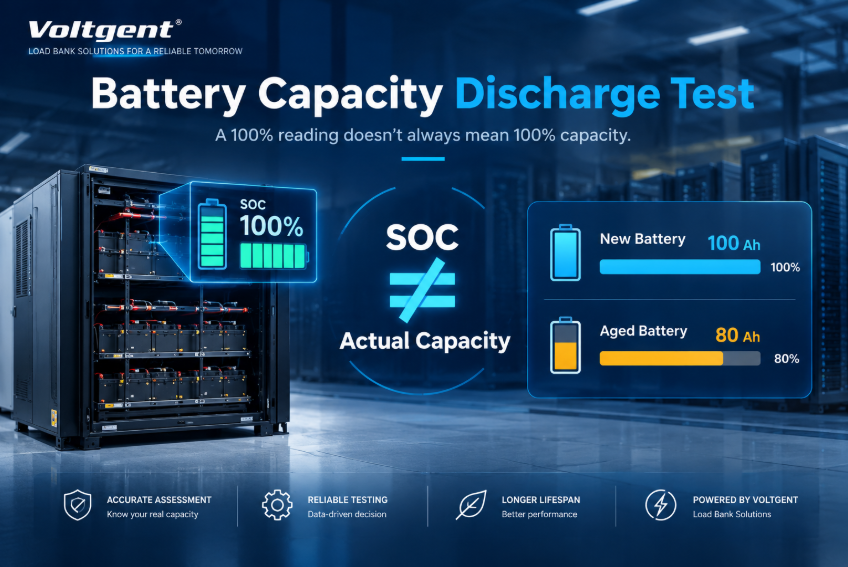
1. SOC 100% ≠ 100% Actual Capacity
To understand battery testing, it is important to distinguish between SOC and Capacity.
SOC (State of Charge) indicates the battery’s current charge level.
For example: SOC = 100%
means the battery is fully charged at that moment.
However, this does not necessarily mean that the battery still has its full rated capacity.
For example, suppose a new battery has a rated capacity of: 100 Ah
After years of operation and aging, it may only be able to deliver: 80 Ah
under the specified test conditions.
Although the battery can still be charged to 100% SOC, its actual available capacity has already decreased.
In simple terms:
SOC answers “How much charge does the battery have now?”
while a capacity test answers:
“How much energy can the battery actually deliver under specified conditions?”
2. What Is a Battery Capacity Discharge Test?
Simply put, a Battery Capacity Discharge Test applies a controlled electrical load to the battery and allows it to discharge under specified conditions. The actual capacity delivered by the battery is then measured.
A typical test records parameters such as:
- Discharge current
- Battery voltage
- Discharge time
- Battery temperature
- End-of-discharge voltage
For a constant-current discharge, the basic relationship can be expressed as:
Capacity (Ah) = Current (A) × Time (h)
For example, if a battery is discharged at a constant current of 20 A and reaches the specified end-of-discharge condition after 4 hours: 20 A × 4 h = 80 Ah
The measured discharge capacity under these test conditions is approximately 80 Ah.
In actual battery testing, the discharge current, end voltage, temperature, and test procedure should be determined according to the battery manufacturer’s specifications and the applicable testing requirements.
3. Why Is a DC Load Bank Needed?
In theory, ordinary electrical equipment can also consume energy from a battery.
However, for a proper capacity test, the load needs to be:
Stable, controllable, and measurable.
This is where a DC Load Bank becomes important.
A DC Load Bank can apply a specified DC load to the battery system, for example:
50 A → 50 A → 50 A → 50 A
During the test, key parameters can be continuously monitored:
Voltage + Current + Time + Temperature
As the battery gradually discharges, its voltage changes. When the specified End-of-Discharge Voltage is reached, the test is terminated.
Therefore, a DC Load Bank is not simply a device for “draining the battery.”
Its real value is to establish a:
controlled, stable, and repeatable discharge test condition.
4. Why Can’t You Evaluate Battery Capacity by Voltage Alone?
This is a common misunderstanding in battery maintenance.
Voltage testing is useful, but:
Normal voltage ≠ Normal capacity.
An aging battery may show a normal voltage when it is at rest, but its voltage can drop rapidly when the battery is subjected to an actual discharge load.
Different tests provide different types of information:
| Test | What It Primarily Tells You |
|---|---|
| Voltage Test | Battery voltage condition |
| SOC | Current state of charge |
| Internal Resistance / Impedance | Diagnostic information about battery condition |
| Capacity Discharge Test | How much capacity the battery can actually deliver under specified conditions |
If the real question is:
“How long can this backup battery actually support the load?”
then the battery’s discharge capacity needs to be verified under appropriate test conditions.
5. Why Does a UPS Need Battery Capacity Testing?
For a UPS system, the battery performs a critical function:
Utility Power Failure → UPS Transfer → Battery Operation → Critical Loads Continue Running
Therefore, one of the key questions is:
“How long can the battery system support the specified load?”
For example, if a data center experiences a power outage and the battery capacity has significantly degraded, the actual UPS backup time may be shorter than originally expected.
A Battery Capacity Discharge Test provides a controlled way to verify the battery system’s actual discharge capability.
The test results can then be compared with:
- The manufacturer’s rated capacity
- Previous test results
- Project requirements
- Applicable testing criteria
This helps identify capacity degradation and provides objective data for battery maintenance and system verification.
6. How Is a Battery Capacity Discharge Test Performed?
The exact test conditions should be determined according to the battery manufacturer’s requirements and the applicable test procedure. However, the basic process can be understood as follows:
① Inspect the Battery System
Check the battery condition, connections, installation, and test environment.
② Fully Charge the Battery
Charge the battery according to the manufacturer’s specified procedure.
③ Connect the DC Load Bank
Connect the DC Load Bank correctly to the battery system.
④ Set the Test Parameters
Set parameters such as:
- Discharge current
- End-of-discharge voltage
- Protection limits
- Test duration, where applicable
⑤ Start the Controlled Discharge
Begin the discharge test and continuously record voltage, current, time, and temperature.
⑥ Reach the End-of-Discharge Condition
Stop the test when the specified end-of-discharge voltage or other defined termination condition is reached.
⑦ Calculate and Analyze the Capacity
Determine the measured discharge capacity and compare it with the rated value or historical test data.
7. A Battery Capacity Test Does Not Mean Discharging the Battery to “0%”
There is an important point to clarify:
A Battery Capacity Discharge Test is not the same as discharging a battery until it reaches 0% on a display.
Industrial battery testing should be terminated according to the specified:
End-of-Discharge Voltage
The discharge current, end voltage, temperature, and other test conditions can vary depending on the battery type, model, manufacturer, and applicable testing requirements.
Therefore, there is no universal rule such as “always discharge the battery to a certain percentage.”
The test should be performed according to the battery manufacturer’s specifications and applicable testing standards.
8. DC Load Bank: Turning “How Long Can It Last?” into a Measurable Result
For UPS, data center, telecommunications, and industrial backup power systems, simply seeing:
Battery = 100%
does not provide a complete picture of battery condition.
What needs to be verified is:
How much capacity can the battery actually deliver under specified test conditions?
A DC Load Bank provides:
- Controlled DC Load
- Stable Discharge
- Accurate Monitoring
- Repeatable Testing
- Capacity Verification
The overall testing process can be simplified as:
Battery
↓
DC Load Bank
↓
Controlled Discharge
↓
Voltage + Current + Time
↓
Measured Capacity
This transforms battery capacity from an assumption into a measurable test result.
VG Load Bank: DC Load Bank Solutions for Battery Testing
VG Load Bank provides DC Load Bank solutions for battery, UPS, and DC power system testing.
Our solutions can be used for:
- Battery Capacity Discharge Testing
- UPS Battery Testing
- DC Power System Testing
- Telecom Battery Testing
- Battery Commissioning
- Backup Power Verification
The test solution can be configured according to project requirements, including:
- DC voltage
- Discharge current
- Load resolution
- Test duration
- Monitoring and data acquisition requirements
For backup power systems, the most important question is not simply:
“How much charge does the battery display?”
It is: “When the power is actually needed, how much capacity can the battery deliver?”
That is the purpose of a Battery Capacity Discharge Test.
By applying a controlled and measurable load, battery testing can provide objective data on actual discharge capacity and help operators verify the performance of critical backup power systems.