

When a diesel generator is running, it is easy to understand why it produces noise.
Engine combustion, mechanical movement, cooling fans, and the exhaust system all contribute to the overall sound level.
But this raises an interesting question:
Why can a resistive load bank, which has no diesel engine at all, still produce a noticeable roaring sound when operating at full load?
Is it the sound of high electrical current?
Are the resistive elements making noise?
Or does most of the noise come from the cooling fans?
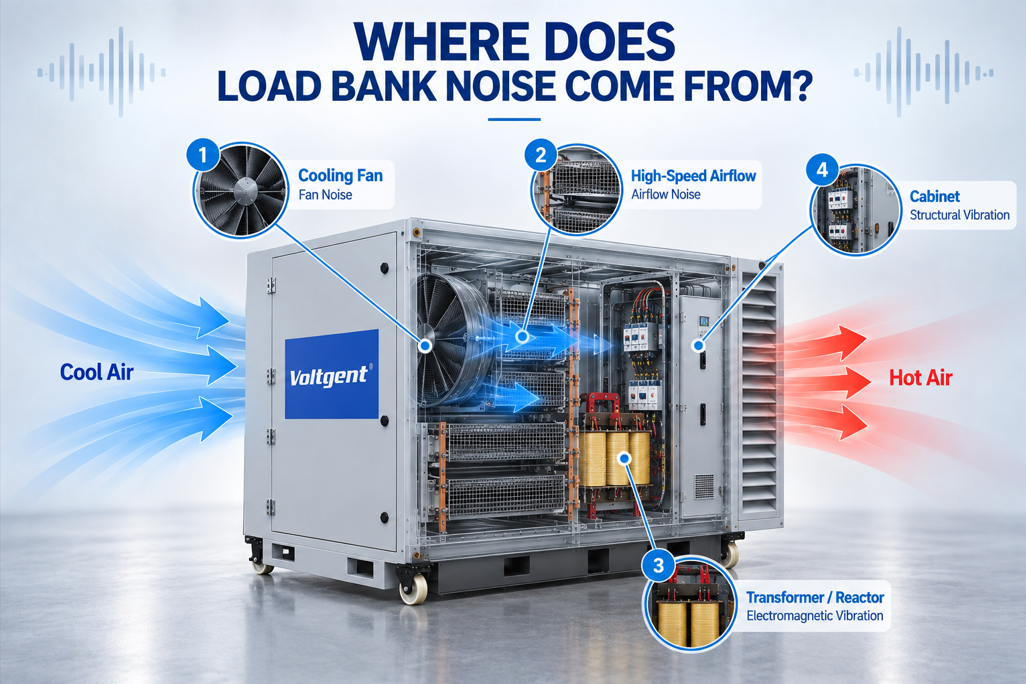
For most forced-air-cooled resistive load banks, the dominant operating noise is generally not produced by the resistive elements themselves. Instead, it is mainly associated with cooling fans, high-velocity airflow, electromagnetic components, and structural vibration.
To understand where load bank noise comes from, we first need to look at what happens to the electrical energy absorbed by a resistive load bank.
What Happens to the Electrical Energy in a Resistive Load Bank?
The basic principle of a resistive load bank is relatively simple:
Electrical Energy → Resistive Elements → Heat
When a load bank is connected to a generator, UPS, or another power source, its resistive elements absorb electrical energy and convert most of that energy into heat.
For example, when a 1000 kW resistive load bank operates close to full load, it must handle approximately 1 MW of electrical load.
That energy is ultimately released primarily as heat.
The next question is obvious:
Where does all that heat go?
It cannot remain inside the load bank. Otherwise, the temperature of the resistive elements, cables, terminals, and other electrical components would rise rapidly.
This is why high-capacity resistive load banks commonly use forced-air cooling.
Cooling fans continuously draw ambient air into the load bank. The air passes through or around the heated resistor section, absorbs the generated heat, and is then discharged from the unit as hot air.
This cooling process is also one of the main reasons why a load bank can be noisy during operation.
Cooling Fan Noise — One of the Main Sources of Load Bank Noise
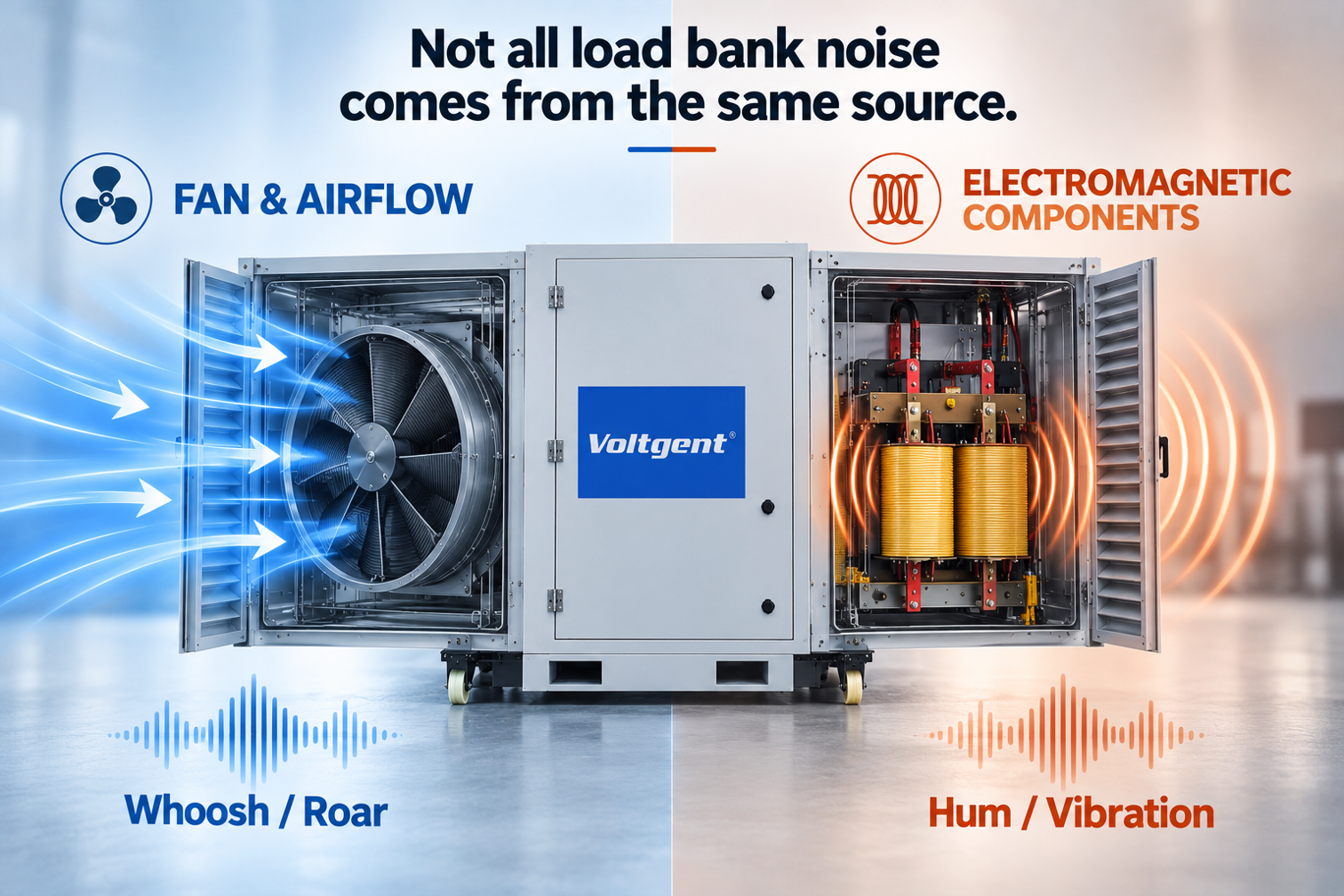
If you stand next to a large load bank during operation, you may hear a continuous:
“Whoosh…” or “Roar…”
A significant part of this sound may come from the cooling fans.
As fan blades rotate at high speed, they continuously interact with the surrounding air and create periodic pressure fluctuations. At the same time, the fan motor, bearings, and mechanical assembly can also generate vibration and mechanical noise.
The required airflow is closely related to the amount of heat that must be removed.
For a load bank rated at several hundred kilowatts or even several megawatts, the amount of heat generated is substantial. The cooling system therefore needs to move a large volume of air continuously through the equipment.
In many cases:
The “roaring” sound you hear from a load bank is largely the sound of its cooling system doing its job.
Airflow Noise — The Air Itself Can Also Generate Sound
One point is easy to overlook:
Fan Noise ≠ Airflow Noise
The cooling fan itself produces noise, but high-speed airflow can also become an important source of sound.
After entering the load bank, cooling air may travel through a path such as:
Air Intake → Cooling Fan → Resistive Elements → Internal Air Duct → Hot-Air Outlet
Along this path, the air may pass through louvers, protective grilles, resistor assemblies, structural supports, and changes in duct geometry.
When high-velocity air interacts with these components, turbulence and pressure fluctuations can develop. These effects can create aerodynamic noise.
A simple example is a hair dryer.
Not all of the sound we hear comes from its electric motor. The high-speed air moving through the internal duct and outlet also contributes significantly to the overall noise.
A high-power resistive load bank works on a similar principle.
The fan moves the air, while the high-speed air moving through the load bank and leaving the discharge outlet creates additional aerodynamic noise.
Together, fan noise and airflow noise often form the continuous roaring sound heard around a forced-air-cooled load bank.
Electromagnetic Noise — Where Does the “Hum” Come From?
Besides airflow noise, another type of sound may sometimes be heard:
“Hummm…”
This low-frequency hum is different from the typical sound of moving air.
It is sometimes described simply as:
“A large current is flowing through the equipment, so the electricity is making noise.”
Technically, that explanation is not quite accurate.
Electrical current itself does not directly produce audible sound in the way a loudspeaker does.
However, if a load bank or associated system contains electromagnetic components such as transformers, reactors, contactors, or other magnetic devices, alternating electromagnetic fields can cause small mechanical movements or vibrations within these components.
For example, transformer cores can experience effects such as magnetostriction, which can produce periodic mechanical vibration.
These vibrations are then transferred to the surrounding structure and air, creating the low-frequency hum that we hear.
So a more accurate explanation is:
It is not simply “electricity making noise.” Electromagnetic forces cause physical components to vibrate, and those vibrations generate audible sound.
It is also important to note that not every load bank produces significant electromagnetic noise.
A straightforward resistive load bank may have a very different acoustic profile from equipment incorporating large transformers, reactors, or inductive load sections.
Structural Vibration — The Load Bank Enclosure Can Also Amplify Noise
Another commonly overlooked source of load bank noise is structural vibration.
Vibration generated by fans, motors, transformers, reactors, or other internal components can travel through the mechanical structure:
Component → Mounting Point → Frame → Metal Panel
If the vibration characteristics of a structural component are close to an excitation frequency, the structural response may become more noticeable.
As a result, a door panel, enclosure section, or frame member may appear to be “making noise.”
But this does not necessarily mean that the metal panel itself is the original noise source.
The actual vibration may originate from an internal component, while the enclosure acts as part of the transmission path — and in some cases makes the vibration easier to hear.
Whoosh, Roar, Hum, and Click — What Do Different Load Bank Sounds Mean?
Different sounds may be associated with different parts of a load bank:
| Sound | Possible Main Source |
|---|---|
| Continuous “whoosh” | High-speed airflow |
| Strong “roar” | High-volume cooling fans + airflow noise |
| Low-frequency “hum” | Transformers, reactors, or other electromagnetic components |
| “Click” or “clack” | Contactors, circuit breakers, or switching devices operating |
| Enclosure or panel vibration | Vibration transmitted from fans or other internal components |
However, sound alone should not be used to determine whether a load bank has a fault.
Actual load bank noise depends on many factors, including:
- Load bank capacity
- Fan type and rotational speed
- Required cooling airflow
- Internal airflow path
- Electrical configuration
- Mechanical construction
- Installation method
- Distance from surrounding structures
- Operating environment
The same rated load bank can therefore sound quite different depending on its design and installation conditions.
Why Is Airflow So Important in High-Power Load Banks?
There is one fundamental principle behind both load bank cooling and load bank noise:
A resistive load bank does not simply absorb electrical power. It must also safely remove the resulting heat.
For a resistive load bank, the energy conversion process can be simplified as:
Electrical Power
↓
Resistive Elements
↓
Heat
↓
Forced-Air Cooling
↓
Hot-Air Discharge
As the load increases, the amount of heat that must be removed generally increases as well.
Therefore, in load bank design, airflow and cooling are first and foremost thermal-management and equipment-safety considerations. Noise is a consequence that must also be considered.
This is why evaluating a load bank should involve more than asking:
“How many kW can it handle?”
Other important questions include:
What cooling method does it use?
How much cooling airflow is required?
Where does the cooling air enter?
Where is the hot air discharged?
Is sufficient clearance available around the load bank for unrestricted airflow?
These factors can affect not only noise but also the thermal performance and safe operation of the equipment.
So, Where Does Load Bank Noise Actually Come From?
For a typical forced-air-cooled resistive load bank, the audible operating noise can generally be divided into several sources:
Cooling Fan Noise + Airflow Noise + Electromagnetic/Mechanical Vibration + Structural Noise
Among these, cooling fan noise and high-speed airflow are often the most obvious sources of the characteristic roaring sound.
The primary job of the resistive elements, meanwhile, is not to generate sound.
Their job is to: Convert electrical energy into heat.
And to remove that heat safely, the cooling system must continuously move large volumes of air through the load bank.
So the next time you stand beside a resistive load bank operating at full load and hear that continuous roar, there is a simple way to understand what is happening:
The resistors convert electricity into heat. The fans and airflow carry that heat away.
And much of the sound we hear is a by-product of that cooling process.
FAQ
Do resistive elements themselves produce a lot of noise?
Usually, the resistive elements themselves are not the dominant noise source in a forced-air-cooled resistive load bank.
In normal operation, cooling fans, high-speed airflow, mechanical vibration, and structural vibration are generally more noticeable.
Why does a load bank require so much airflow?
A resistive load bank converts most of the electrical energy it absorbs into heat.
A high-power load bank therefore needs to continuously remove a substantial amount of heat. Forced-air cooling provides the airflow required to carry that heat away from the resistor section and discharge it safely.
Is the humming sound from a load bank the sound of electrical current?
Not exactly.
Transformers, reactors, and other electromagnetic components can experience small mechanical vibrations under alternating electromagnetic fields. Those vibrations can then create audible low-frequency humming.
In other words, the sound is generally produced by mechanical vibration caused by electromagnetic effects, rather than electrical current directly producing sound.
Does a higher load always make a load bank louder?
Not necessarily.
The relationship between load level and noise depends on the load bank’s cooling-control strategy and overall design.
For example, some load banks operate their cooling fans at a fixed speed once the fans are switched on. In such a design, increasing the electrical load does not necessarily result in a proportional increase in operating noise.
Other designs may use different fan-control strategies, so the acoustic behavior can vary from one load bank to another.