

The load bank appears to be operating normally. The cooling fans are running, and everything looks fine when the test begins.
But as the load test continues, the air temperature around the load bank inlet gradually rises. Eventually, the unit may trigger a High Temperature or Over-Temperature Protection alarm.
The first reaction might be:
Is the load bank cooling capacity insufficient?
Not necessarily.
Sometimes, the problem is not inside the load bank at all. It is caused by the load bank installation, airflow arrangement, or test environment.
The load bank may simply be drawing its own hot exhaust air back into the cooling air inlet.
This phenomenon is known as Hot Air Recirculation, and it is one of the airflow problems that can easily be overlooked during load bank testing.
A Load Bank Is Not Just an Electrical Device
Before discussing hot air recirculation, consider a simple question:
When a 1000 kW resistive load bank operates at full load, where does that 1000 kW of electrical energy go?
In a resistive load bank, electrical energy is primarily converted into heat through the resistive elements:
Electrical Energy → Resistive Elements → Heat
From the perspective of the test environment, a 1000 kW resistive load bank operating near full load is continuously producing a thermal load on the order of 1 MW.
So a load bank has two important jobs:
It must apply the required electrical load, but it must also remove the resulting heat safely.
Most high-capacity resistive load banks therefore use forced-air cooling:
Cool Air → Fan → Resistive Elements → Hot Air
Ambient air enters the load bank, passes through the heated resistor section, absorbs the heat, and is discharged as hot air.
The real problem often begins at this final stage:
Where does that hot air go after it leaves the load bank?
What Is Hot Air Recirculation?
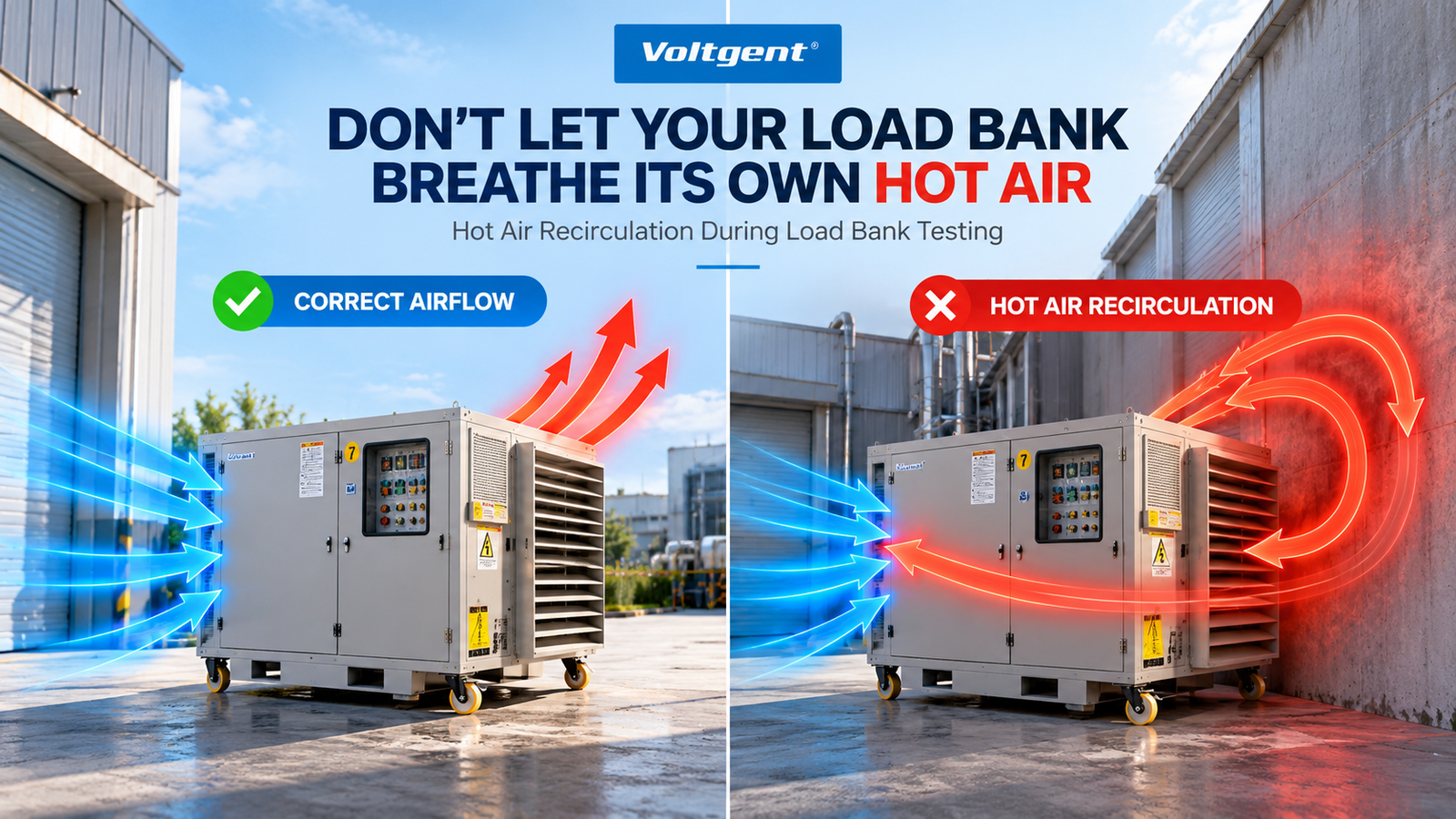
Under ideal conditions, the airflow path should look like this:
Cool Air → Load Bank → Hot Air → Away
Once the heated air leaves the load bank, it should move away from the cooling air inlet.
However, if the load bank is installed incorrectly — for example, if the discharge is too close to a wall, ceiling, another piece of equipment, or another obstruction — the hot exhaust air may not be able to disperse properly.
Instead, the airflow may strike a nearby surface, change direction, and return toward the load bank inlet:
Load Bank → Hot Air Discharge → Recirculation → Air Inlet
The load bank is now no longer drawing only ambient cooling air.
It is drawing a mixture that includes some of the hot air it has just discharged.
This is hot air recirculation.
Simplex, for example, warns in its load bank installation documentation against allowing heated discharge air to be reflected by nearby objects and recirculated into the cooling system. It also notes that operation in confined spaces can allow heated exhaust air to recirculate.
For further reference, see the Simplex Electra Load Bank Manual.
Why Does Hot Air Recirculation Get Worse Over Time?
Suppose the ambient temperature in the test area is 25°C.
Under normal conditions, the load bank should continuously draw cooling air at approximately that temperature.
But if part of the hot discharge air returns to the inlet, the actual air entering the load bank may be significantly warmer than the ambient air elsewhere in the room.
The process can then develop like this:
Hot Air Returns
↓
Inlet Air Temperature Increases ↑
↓
Cooling Margin Decreases↓
↓
Internal Temperature Increases ↑
If the test continues and the hot air cannot be removed effectively from the area, the thermal conditions around the load bank can progressively deteriorate.
Eventually, the unit may trigger a high exhaust temperature alarm or over-temperature protection.
Simplex also lists checking whether hot air is recirculating back into the load bank inlet as one of the troubleshooting steps associated with high exhaust temperature.
See the Simplex Load Bank Troubleshooting Guide for additional reference.
So when a load bank begins to overheat, it may be worth checking the airflow path before immediately asking:
“Is there something wrong with the resistor or cooling design?”
The problem may simply be:
The load bank is breathing its own hot air.
Where Is Hot Air Recirculation Most Likely to Occur?
Hot-Air Discharge Too Close to a Wall
If high-temperature air is discharged directly toward a nearby wall, the airflow can be deflected.
Part of that air may then travel back toward the cooling air inlet.
Intake and Exhaust Airflow Form a “Short Circuit”
This happens when discharged hot air finds a short path back to the inlet instead of leaving the test area.
In airflow terms, the cooling system is moving plenty of air — but some of that air is simply circulating around the load bank rather than carrying heat away from it.
Testing in Small or Semi-Enclosed Spaces
Even if there is no obvious local recirculation path, a confined space can still create thermal problems if it does not have sufficient ventilation.
As the test continues, more and more heat is released into the room.
Multiple Load Banks Operating Together
When several load banks operate simultaneously, airflow planning becomes even more important.
It is no longer enough to consider the exhaust air from each individual unit.
You also need to ask:
Could the hot-air discharge from Load Bank A become the cooling-air intake for Load Bank B?
This can become particularly important during high-capacity generator testing, data center commissioning, or other applications where several load banks operate in the same area.
Hot Air Recirculation Is Not the Same as Room Heat Build-Up
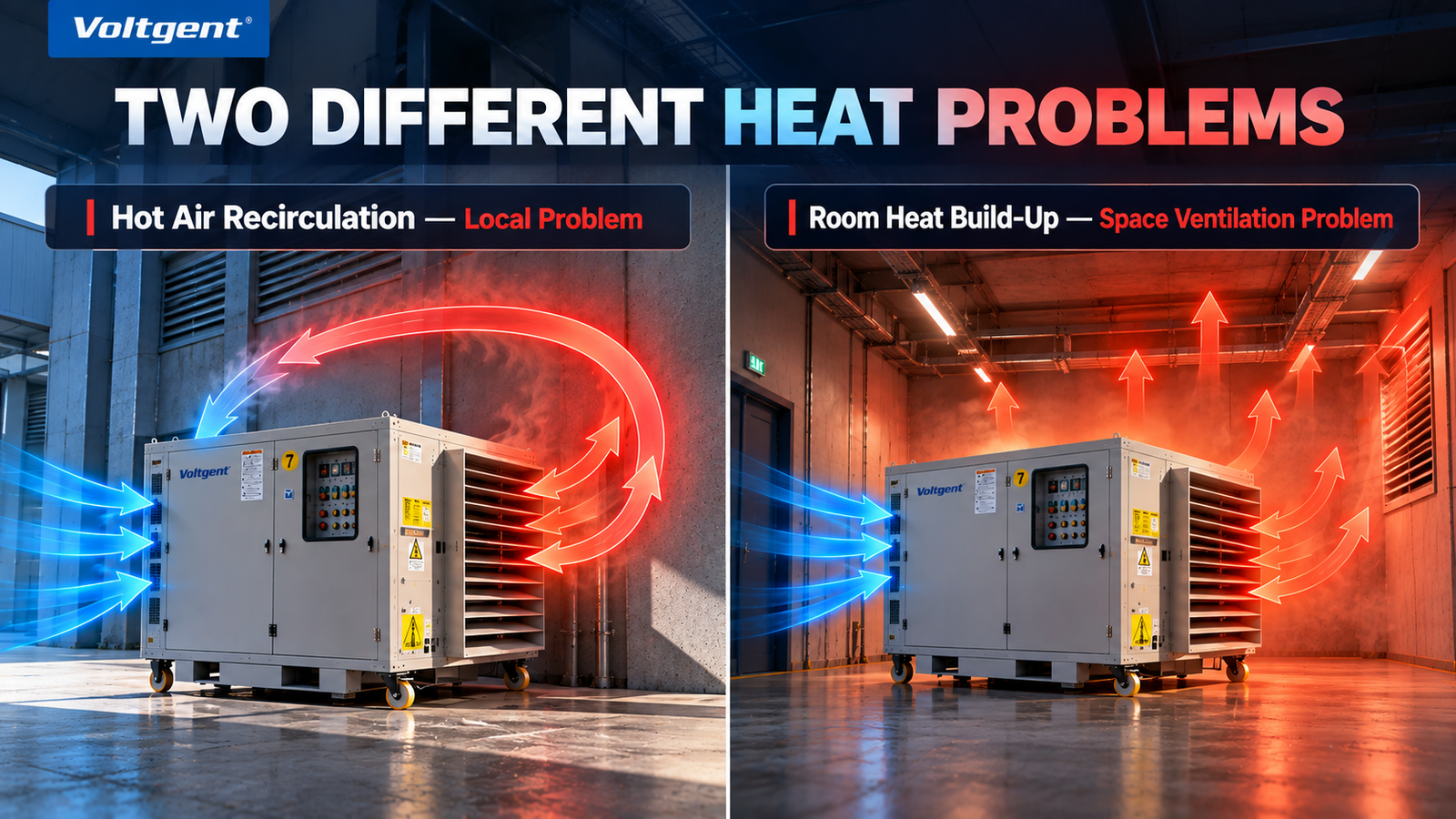
These two problems are related, but they are not the same.
Hot Air Recirculation means:
Heated discharge air returns directly or indirectly to the load bank cooling air inlet.
Room Heat Build-Up means:
Heat accumulates throughout the test space because the room cannot remove thermal energy as quickly as the load bank releases it.
Consider a high-power load bank operating inside an enclosed room.
Its intake and discharge arrangement may be well designed, with no obvious local airflow recirculation.
However, if the room itself does not have sufficient ventilation to remove the heat generated by the load bank, the overall ambient temperature will gradually rise.
Therefore:
No obvious hot air recirculation does not necessarily mean the indoor cooling environment is adequate.
For indoor load bank testing, two separate questions should always be considered:
1. Is the hot discharge air finding its way back to the load bank inlet?
and
2. Can the room itself remove the total heat generated during the test?
Both local airflow and overall room ventilation matter.
What Should You Check During Indoor Load Bank Testing?
There is no universal clearance distance that applies to every load bank installation.
Required clearance depends on factors such as:
- Load bank capacity
- Cooling airflow requirement
- Fan design
- Horizontal or vertical air discharge
- Maximum allowable ambient temperature
- Manufacturer-specific installation requirements
For this reason, actual installation clearances should always follow the technical manual for the specific load bank being used.
However, from an airflow and thermal-management perspective, several basic points should be checked before testing:
- Make sure the cooling air inlet is not obstructed by walls, cables, temporary structures, or other equipment.
- Ensure the load bank has access to sufficient cooling air.
- Make sure hot discharge air can actually leave the test area.
- Avoid creating a short airflow path between the hot-air outlet and cooling-air inlet.
- Confirm that the room ventilation system can handle the heat released during testing.
- When multiple load banks are operating, make sure one unit does not draw in another unit’s hot exhaust air.
- Monitor the air temperature at or near the actual load bank intake, not only the general room temperature.
The last point is particularly important.
A temperature sensor on the opposite side of the room may show only 28°C, for example.
But if localized hot-air recirculation exists around the load bank, the air actually entering its cooling inlet may be considerably hotter.
Therefore, a single room ambient temperature measurement may not accurately represent the cooling conditions experienced by the load bank itself.
Don’t Just Look at kW — Look at Where the Hot Air Goes
During a load bank test, engineers naturally pay close attention to electrical parameters such as:
Voltage, Current, Frequency, kW, kVA, and Power Factor.
But for a forced-air-cooled resistive load bank, there is another parameter that deserves just as much attention:
Airflow.
The complete energy path looks something like this:
Electrical Load
↓
Heat
↓
Cooling Air
↓
Hot-Air Discharge
The electrical load determines how much heat is generated.
The airflow determines whether that heat can be safely removed from the load bank and the surrounding test environment.
That means deciding where to position a load bank is not simply a question of:
“Is there enough physical space for the equipment?”
It should also include three additional questions:
Where will the load bank draw its cooling air from?
Where will the hot air be discharged?
And after it is discharged, could that hot air return to the inlet?
For a reliable load bank test, the test environment itself should be treated as part of the overall test setup.
FAQ: Hot Air Recirculation and Load Bank Installation
What is hot air recirculation in a load bank?
Hot air recirculation occurs when heated air discharged from a load bank returns to its cooling air inlet instead of moving away from the equipment.
This increases the load bank inlet air temperature and reduces the available cooling margin.
Can hot air recirculation cause a load bank to overheat?
Yes. If hot discharge air repeatedly returns to the cooling inlet, the load bank may operate with an inlet temperature significantly higher than the surrounding ambient temperature.
This can contribute to higher internal temperatures and may eventually result in a high-temperature alarm or over-temperature shutdown, depending on the load bank design and operating conditions.
How much clearance does a load bank need?
There is no single clearance distance that applies to every load bank.
The required distance depends on the load bank capacity, cooling airflow, discharge direction, fan design, operating environment, and manufacturer requirements.
Always follow the installation and clearance requirements specified in the manual for the particular load bank.
Can a load bank be operated indoors?
A load bank can be operated indoors when the installation and test environment are designed appropriately for the equipment.
The room must provide sufficient cooling air and must also be capable of removing the heat generated during testing. Hot-air recirculation, ventilation capacity, equipment clearances, and maximum allowable ambient temperature should all be considered.
Is room temperature enough to determine whether a load bank has adequate cooling?
Not always.
The general room temperature may be acceptable while localized hot-air recirculation causes a much higher temperature directly at the load bank inlet.
For this reason, monitoring the temperature near the actual cooling-air intake can provide a more useful indication of the thermal conditions experienced by the load bank.