

Imagine you need to test a 2,000 kW generator. The obvious solution might be to use a single 2,000 kW load bank.
But what if your next project only requires 500 kW? And the one after that needs 1,500 kW?
For companies handling different testing capacities across multiple project sites, a single large load bank may not always be the most flexible option.
This is where modular load bank systems come in. By combining multiple load bank units, testing capacity can be adjusted to suit different project requirements — much like building with blocks.
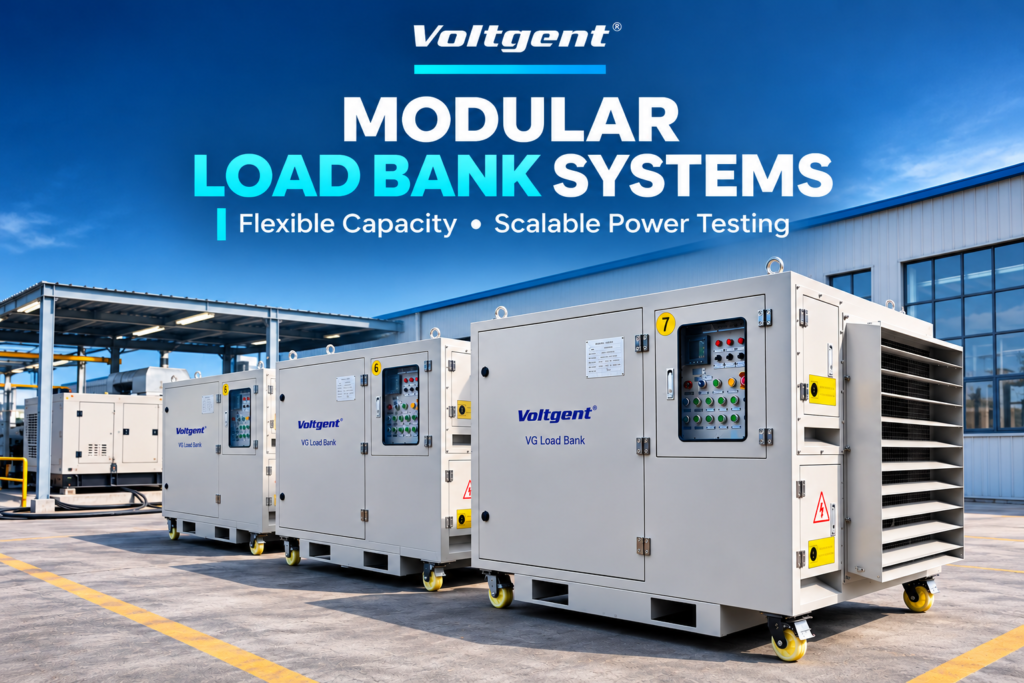 What Is a Modular Load Bank System?
A modular load bank system uses multiple independent load bank units that can be combined to achieve different testing capacities.
For example, consider four load banks, each rated at 500 kW.
For a 500 kW test, you can use just one unit. For a 1,000 kW test, two units can work together. And when a project requires 2,000 kW, all four units can be connected to provide the required capacity.
This allows the same equipment fleet to support projects of different sizes without deploying every unit each time.
However, modular does not mean that any load banks can simply be connected together. Their rated voltage, frequency, electrical connections and protection systems must be compatible with the testing setup.
Why Use Multiple Smaller Load Banks?
Compared with a single large load bank, a modular configuration offers three main advantages.
Flexible Testing Capacity
Different projects may require 500 kW, 1,000 kW or 2,000 kW of testing capacity.
A modular system allows operators to select the number of units needed for each project, making equipment allocation more flexible.
Easier Transportation and Site Arrangement
Transporting and positioning a single 2,000 kW load bank may require special consideration for lifting equipment, vehicle access and available space.
Several smaller units can be transported separately and positioned according to site conditions.
However, more units also mean additional power cables, connections and installation coordination.
Better Equipment Sharing
For load testing service providers and rental companies, individual load banks can be deployed to different projects simultaneously.
When higher testing capacity is required, compatible units can be brought together.
This flexibility can be particularly valuable for businesses managing multiple projects with changing power requirements.
How Do Multiple Load Banks Work Together?
Multiple load banks can be connected to a common test power source through appropriately designed individual power connections and protection systems.
There are generally two control approaches:
Independent Control
Each load bank is operated separately, with technicians coordinating the loading and unloading of individual units.
Master-Slave Control
In a compatible system, a master controller can coordinate multiple load bank units through a centralized control interface.
For example, when a 1,500 kW test load is required, the control system may distribute the demand across three 500 kW units.
It is important to understand that connecting multiple load banks to the same power source does not automatically provide master-slave control.
Centralized operation, automatic load distribution and coordinated load switching require suitable control hardware, communication interfaces and software.
Modular Load Banks vs. a Single Large Load Bank
| Comparison | Single 2,000 kW Load Bank | Four 500 kW Load Banks |
| Total Rated Capacity | 2,000 kW | 2,000 kW |
| Capacity Configuration | Adjustable through internal load steps | Flexible combination of individual units |
| Transportation | One large unit | Units can be transported separately |
| Site Arrangement | Fewer equipment connections | Flexible positioning, but more connections |
| Control | Typically centralized | Independent or compatible centralized control |
| Equipment Sharing | Usually deployed as one unit | Units can be allocated to different projects |
| Cost Considerations | Fewer units and connections | May require additional cables, controls and maintenance |
A modular system is not necessarily cheaper than a single large load bank.
If the testing capacity is relatively fixed and most tests are performed at one location, a single large load bank may offer a simpler and more economical solution.
On the other hand, when project sizes and locations frequently change, modular load banks may provide greater operational flexibility.
Where Are Modular Load Bank Systems Most Useful?
Generator Manufacturers
Manufacturers testing generators of different power ratings can combine load bank units according to the required test capacity.
Load Testing Service Providers
Testing companies can allocate individual units to different customer sites and combine them when larger testing capacities are needed.
Data Centers and Large Power Projects
With appropriate electrical distribution, controls and protection, multiple load bank units can be used together to support different stages of power system testing and commissioning.
For companies planning to increase their testing capacity over time, a modular approach can also support phased equipment investment.
However, future load bank capacity expansion must account for electrical distribution capacity, cable sizing, protection coordination, control compatibility and heat dissipation.
Conclusion: More Testing Capacity Doesn’t Always Require One Bigger Load Bank
Choosing a load bank involves more than selecting the required power rating.
Transportation, project locations, equipment utilization and future expansion plans can all influence the most suitable configuration.
A single large load bank may be ideal for fixed, high-capacity testing applications. Modular load bank systems, meanwhile, offer greater flexibility for companies working across multiple projects and power ratings.
The real value of modular load banks is not simply connecting several units together — it is having the flexibility to adapt testing capacity to actual project requirements.
FAQ:
Q1. Can multiple load banks be connected in parallel?
Yes. Multiple load banks can be connected to a common power source through properly designed individual electrical connections and protection systems. Voltage, frequency, system capacity and safety requirements must be verified before testing.
Q2. What is master-slave control in a load bank system?
Master-slave control is a centralized control arrangement in which a master controller coordinates loading and unloading commands across multiple compatible load bank units. Available functions depend on the specific control system design.
Q3. Is a modular load bank system cheaper than a single large load bank?
Not necessarily. Modular systems may improve equipment utilization and transportation flexibility, but they can also increase cabling, control and maintenance costs. The best choice depends on testing frequency and total cost of ownership.
Q4. Can modular load bank capacity be expanded later?
Yes, provided the system is designed to accommodate additional compatible units. Electrical distribution, cabling, protection, control compatibility and cooling requirements must all be considered before expansion.