

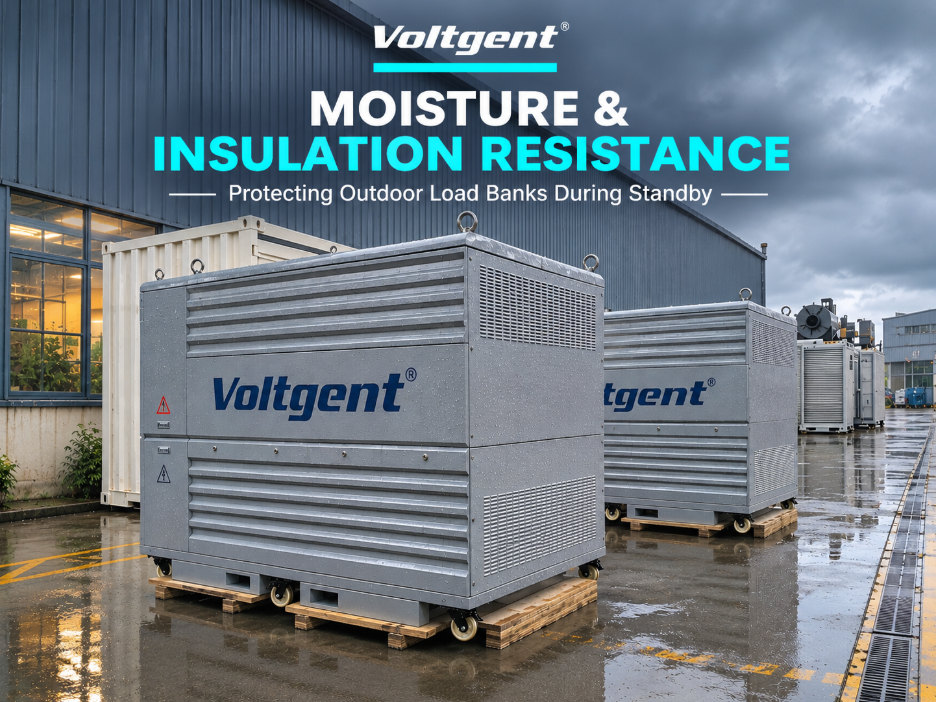
A load bank has been sitting outdoors for several months. The enclosure looks fine, and there is no visible water inside.
Is it safe to switch it on immediately?
Not necessarily.
In humid, rainy environments or locations with significant temperature changes, moisture can accumulate inside electrical enclosures even without direct rainwater ingress.
Over time, condensation may affect electrical insulation, increasing the risk of leakage currents and electrical faults.
This is why insulation resistance testing may be an important part of checking a load bank before returning it to service after extended storage or suspected moisture exposure.
Why Does Condensation Form Inside Outdoor Load Banks?
Have you ever noticed water droplets forming on a cold window or metal surface during humid weather?
The same principle applies to industrial electrical equipment.
For example, a load bank may cool down overnight. When warmer, humid air enters the enclosure the following morning, moisture can condense on internal surfaces if their temperature falls below the dew point.
This process is known as condensation.
Even an enclosure designed for outdoor use is not necessarily free from internal moisture. Humidity, temperature fluctuations, enclosure sealing and storage conditions can all influence condensation risk.
It is also important to distinguish high humidity from actual condensation. Moist air alone does not automatically cause water droplets to form; the surface temperature must fall below the dew point.
For more information about moisture buildup and condensation prevention in electrical enclosures, see Rittal’s guide on moisture in enclosures.
How Does Moisture Affect Load Bank Insulation Resistance?
Electrical insulation helps prevent unwanted current flow between energized conductors and grounded metal structures.
However, when moisture settles on insulating surfaces, particularly when mixed with dust, salt or other contaminants, it can create conductive paths and increase leakage currents.
Potential consequences include:
- Reduced insulation resistance
- Increased electrical leakage current
- Greater risk of surface tracking or electrical flashover
- Insulation failure or short circuits in severe cases
These risks deserve particular attention for load banks stored or operated in coastal, humid or dusty environments.
However, low insulation resistance does not always indicate moisture damage. Insulation aging, mechanical damage and contamination may also contribute to poor test results.
What Is a Megger Test?
An insulation resistance test, often called a Megger test, is performed using an insulation resistance tester or megohmmeter.
The instrument applies a specified DC test voltage to an appropriately isolated electrical circuit and measures its insulation resistance.
For load banks that have been stored for extended periods, exposed to water or suspected of moisture contamination, insulation resistance testing may form part of the inspection process before the equipment is returned to service.
However, there is an important precaution:
A Megger test should not be performed indiscriminately across an entire load bank.
Load banks may contain electronic controllers, digital meters, semiconductor devices, surge protection components and other equipment that could be damaged by the applied DC test voltage.
Testing must therefore be carried out by qualified personnel following the manufacturer’s procedures, with the equipment safely de-energized, isolated and the relevant sensitive circuits disconnected where required.
The appropriate test voltage and acceptable insulation resistance values depend on the equipment rating, applicable standards and manufacturer’s requirements. There is no single pass/fail value suitable for every load bank.
For additional testing precautions, refer to Megger’s technical article, Seven Tips for Insulation Resistance Testing.
How Does an Anti-Condensation Heater Help?
While insulation resistance testing helps assess electrical insulation condition, preventing condensation is equally important.
An anti-condensation heater is a small heating device installed inside an electrical enclosure, typically used when the equipment is switched off or on standby.
By maintaining a suitable internal temperature, it helps reduce the likelihood of moisture condensing on electrical components and insulating surfaces.
This can be particularly useful for load banks installed in humid environments, exposed to significant day-to-night temperature changes or left unused for extended periods.
VG Load Bank can provide anti-condensation heaters as an optional feature, depending on the application and environmental conditions.
However, an anti-condensation heater does not make the enclosure completely moisture-proof.
Its effectiveness depends on the power supply, control arrangement, heater placement and actual environmental conditions. Proper enclosure sealing, cleaning, inspection and maintenance remain essential.
Anti-Condensation Heater vs. Insulation Resistance Testing
These two measures serve different purposes: one helps prevent condensation, while the other helps assess insulation condition.
| Comparison | Anti-Condensation Heater | Insulation Resistance Test |
|---|---|---|
| Main Purpose | Reduce condensation risk | Assess insulation condition |
| Working Principle | Maintains suitable internal or surface temperatures | Applies a specified DC voltage to measure insulation resistance |
| When Used | Typically during shutdown or standby | After de-energization and safe isolation |
| Repairs Existing Insulation Faults? | No | No |
| Replaces Routine Maintenance? | No | No |
An anti-condensation heater and an insulation resistance test are therefore not interchangeable.
The heater helps reduce the likelihood of moisture-related problems, while insulation resistance testing provides information about the condition of the electrical insulation.
What Should Be Checked Before Restarting a Load Bank After Long-Term Storage?
For load banks stored outdoors or in humid conditions, several checks may be appropriate before returning the equipment to service:
- Inspect enclosure seals, ventilation openings and internal surfaces for water ingress or visible condensation.
- Check electrical connections, insulation materials and metal components for contamination, corrosion or damage.
- Determine whether insulation resistance testing is required based on the manufacturer’s maintenance instructions and equipment condition.
- If moisture or insulation abnormalities are found, investigate and correct the cause before returning the equipment to operation.
One practice to avoid is energizing equipment with known insulation problems simply to generate heat and dry the internal components.
Any necessary drying, cleaning, repair and retesting should follow an appropriate maintenance procedure.
Conclusion: Moisture Protection Is More Than Keeping Rain Out
For outdoor load banks, direct rainwater ingress is only one potential moisture-related risk.
Even without visible water entry, humid air, temperature fluctuations and condensation may affect internal electrical insulation.
Appropriate enclosure design, anti-condensation measures and insulation condition checks can help reduce electrical risks when equipment is returned to service after extended periods of inactivity.
Effective moisture protection is not just about keeping the outside dry. It is also about maintaining reliable electrical insulation inside the equipment.
FAQ: Load Bank Insulation Resistance
Q1. Why does moisture reduce load bank insulation resistance?
Moisture can combine with dust, salt and other contaminants to create conductive paths on insulating surfaces. These paths increase leakage currents and may reduce measured insulation resistance.
Q2. When should insulation resistance be tested on a load bank?
Testing may be appropriate after extended storage, water ingress, suspected moisture exposure or indications of insulation deterioration. The decision should follow the manufacturer’s maintenance requirements and be carried out by qualified personnel.
Q3. What does an anti-condensation heater do in a load bank?
An anti-condensation heater helps maintain suitable internal or surface temperatures, reducing the likelihood of condensation forming on electrical components during standby or storage.
Q4. Can a load bank operate if its insulation resistance is too low?
If the measured insulation resistance is below the applicable acceptance criteria, the equipment should not be returned to service until the cause has been investigated, necessary corrective action has been completed and the required checks confirm that it is safe to operate.