

When a car accelerates suddenly, its engine must quickly deliver more power.
A diesel generator faces a similar challenge when a large electrical load is suddenly connected.
Can the generator respond quickly enough? How much will its voltage and frequency change? And how long will it take to recover?
These are the key questions addressed by generator transient response testing.
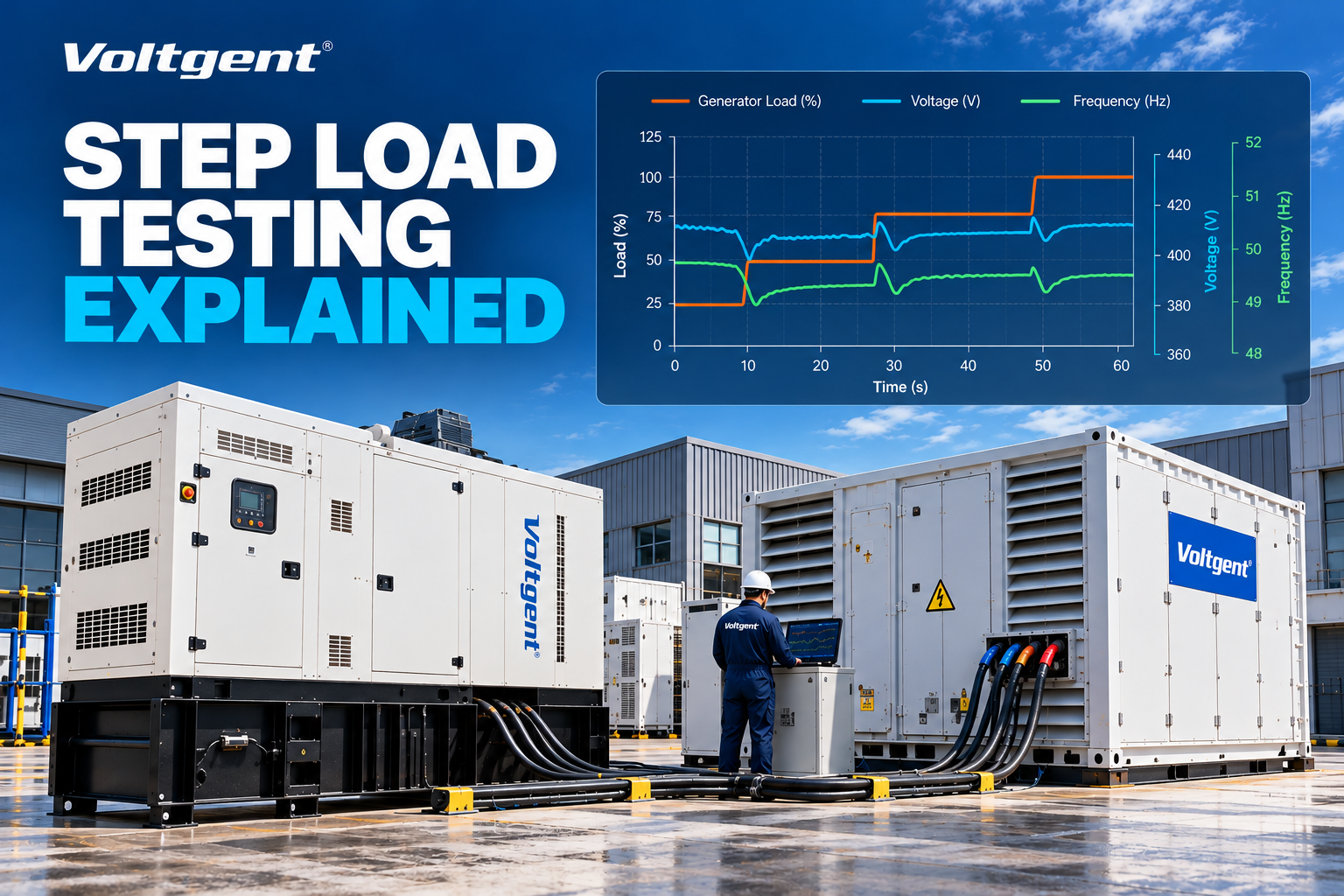
What Is Generator Transient Response?
Generator transient response refers to the temporary changes in output voltage and frequency when an electrical load is suddenly applied or removed, and how quickly the generator returns to stable operating conditions.
There are two main types of tests:
- Step Load / Load Acceptance: A sudden increase in electrical load may cause a temporary frequency drop and voltage dip while the engine and excitation system respond.
- Load Rejection: When a large load is suddenly removed, engine speed and frequency may briefly rise, and the output voltage may experience an overshoot.
The two tests evaluate different aspects of generator performance:
| Parameter | Step Load (Load Acceptance) | Load Rejection |
| Load change | Sudden increase | Sudden decrease |
| Frequency response | May temporarily decrease | May temporarily increase |
| Voltage response | May experience a voltage dip | May experience voltage overshoot |
| Main objective | Evaluate load acceptance capability | Evaluate stability after load removal |
| Key measurements | Maximum deviation and recovery time | Maximum deviation and recovery time |
Actual transient behavior depends on the engine, alternator, governor, automatic voltage regulator (AVR), and load characteristics.
Why Do Voltage and Frequency Change?
During stable operation, the engine supplies the mechanical power required by the electrical load.
When a large load is suddenly applied, the engine cannot increase its mechanical output instantaneously. As a result, engine speed may temporarily decrease, causing a frequency dip.
At the same time, the alternator’s electromagnetic response and excitation characteristics may cause a temporary voltage dip.
Two control systems play important roles in restoring stability:
- Governor: Adjusts engine power output to help restore speed and frequency.
- Automatic Voltage Regulator (AVR): Adjusts excitation to help restore the generator’s output voltage.
For additional technical background, refer to Cummins – Considerations for Generator Set Selection.
Why Is Recovery Time Important?
Consider a generator operating at 50 Hz.
When a significant load is suddenly connected, its frequency may briefly drop before gradually returning to the required operating range. The voltage may show a similar transient response.
A generator transient response test therefore evaluates more than whether the generator eventually stabilizes.
It asks three important questions:
How large was the deviation? How long did it last? How quickly did the system recover?
The key measurements include:
- Voltage Dip: The temporary reduction in output voltage.
- Frequency Deviation: The extent to which frequency moves away from its rated value.
- Recovery Time: The time required for voltage or frequency to return to a specified tolerance band.
For applications such as data centers, hospitals, and industrial facilities, transient performance can be an important factor in maintaining stable power for connected equipment.
A generator that meets its rated power output does not necessarily meet the required transient performance.
Why Can’t Every Generator Accept 100% Load in One Step?
Imagine a generator rated at 1,000 kW.
Its ability to continuously deliver 1,000 kW does not automatically mean it can accept the entire load instantaneously from no-load conditions while remaining within the specified voltage and frequency limits.
This is because:
Rated Power ≠ Step Load Acceptance Capability
Depending on the engine characteristics, project requirements, and applicable standards, testing may use a sequence such as:
0% → 25% → 50% → 75% → 100%
At each load step, voltage deviation, frequency deviation, and recovery time can be recorded.
However, this is only an illustrative sequence, not a universal testing requirement. Gradual steady-state loading should also not be confused with step load testing, which requires a defined load change and measurement of the resulting transient response.
ISO 8528-5 addresses generating set performance, including relevant transient characteristics and requirements.
For further information, see Caterpillar – Transient Performance Specifications for Diesel Generator Sets.
How Does a Load Bank Support Transient Response Testing?
To evaluate generator performance during sudden load changes, engineers need a controlled and repeatable electrical load that can be applied or removed according to a defined test procedure.
This is where a load bank becomes valuable.
A suitable load bank can support:
- Controlled Step Loading: Applying or removing specified load steps to evaluate generator response.
- Repeatable Testing: Repeating tests under consistent conditions to compare performance.
- Performance Verification: Working with appropriate measurement equipment to record voltage, frequency, and recovery time.
For projects that require testing at a specified power factor or evaluating reactive load response, a resistive-reactive load bank may be used.
It is important to distinguish between load application and measurement: the load bank provides the controlled electrical load, while accurate transient waveform recording requires measurement equipment with suitable sampling speed and accuracy.
Conclusion: Rated Power Is Only Part of Generator Performance
Generator testing is not simply about confirming whether a unit can reach its rated output.
It is also about understanding how the generator behaves when electrical demand changes suddenly.
Can voltage and frequency recover within the specified limits and time?
That is the purpose of generator transient response testing.
Through properly designed step load and load rejection tests, engineers can evaluate dynamic performance and support generator selection, factory acceptance testing (FAT), and on-site commissioning.
A load bank helps verify not only how much load a generator can carry, but also how it responds when that load changes suddenly.
FAQ: Generator Transient Response Testing
Q1. What is a generator step load test?
A generator step load test involves suddenly applying a specified electrical load and measuring the resulting voltage deviation, frequency deviation, and recovery time. It helps evaluate the generator’s load acceptance capability.
Q2. What is the difference between step load and load rejection testing?
Step load testing evaluates generator response when electrical load suddenly increases, typically focusing on voltage and frequency dips. Load rejection testing evaluates the response when load is suddenly removed, including possible frequency rise, voltage overshoot, and recovery behavior.
Q3. Can every generator accept 100% load in one step?
No. A generator’s ability to accept 100% load in a single step depends on its engine, alternator, control systems, and the specified transient performance requirements. Rated output alone does not guarantee full-load acceptance in one step.
Q4. Why use a load bank for generator transient testing?
A load bank provides controlled, repeatable electrical load steps, allowing engineers to evaluate generator behavior under defined test conditions. When combined with suitable measurement instruments, it supports the assessment of voltage deviation, frequency response, and recovery time.