

Whether a generator is truly reliable at critical moments does not depend on whether it can start, but on whether it can operate stably under load.
For this reason, regular load bank testing is an industry-accepted best practice to verify generator performance and reliability.
A common—but often overlooked—question is:
How often should a generator undergo load bank testing?
Recommended Frequency for Generator Load Bank Testing
The optimal testing frequency depends on operating conditions, application criticality, and usage intensity.
General Industry Recommendations
- Monthly:
Perform a light-load test at approximately 30–40% of rated load for 1–2 hours.
Purpose: verify basic operation, voltage and frequency stability, and control system response. - Semi-annually or annually:
Conduct a full-load test (100% rated load) for 2–4 hours to comprehensively verify:- Output power capability
- Load acceptance performance
- Cooling system efficiency
- Carbon buildup and component wear
- Special cases:
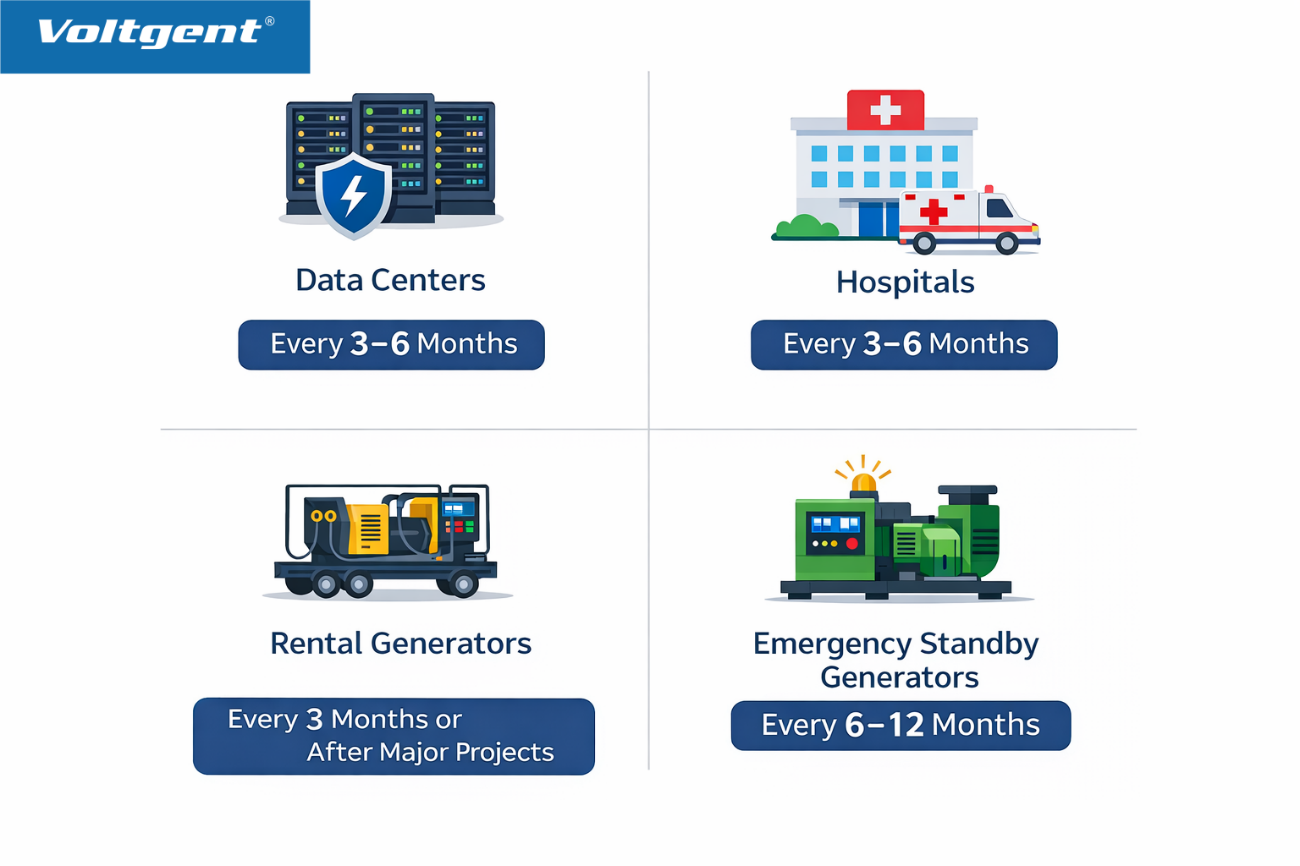
For critical applications (hospitals, data centers, financial facilities), frequently operated generators, or harsh environments, full-load testing may be required quarterly.
Recommended Load Testing Frequency by Application
| Application Scenario | Recommended Load Testing Frequency |
| Data centers, hospitals, airports | Every 3–6 months |
| Emergency standby generators (low operating hours) | Every 6–12 months |
| Rental generators / high-usage units | Every 3 months or after major projects |
| Newly installed or overhauled generators | Mandatory before commissioning |
Why No-Load or Light-Load Operation Is Not Enough
Many generators are only exercised at no-load or very light load during routine maintenance. This practice carries significant risks.
Common Issues Caused by Long-Term Low-Load Operation
- Wet stacking
- Incomplete fuel combustion and carbon buildup in the exhaust system
- Insufficient engine operating temperature
- Degraded sealing and lubrication performance
- Excessive emissions
- High risk of failure under real load conditions
Load bank testing allows operators to simulate real electrical demand without impacting site power consumption, forcing the generator to operate under proper load conditions.
What Should a Standard Load Bank Test Include?
A proper load bank test is more than “connecting a load and running briefly.”
A standard test should meet the following criteria:
| Test Parameter | Industry Recommendation |
| Load level | ≥ 70% of rated power |
| Test duration | 2–4 hours (depending on standards) |
| Load method | Step loading or continuously adjustable load (e.g., 0% → 25% → 50% → 75% → 100% → 110%) |
| Monitored parameters | Voltage, frequency, temperature, oil pressure, emissions |
A professional load bank enables precise load control and systematic verification of generator performance across multiple operating conditions.
Signs That Your Generator Needs Load Bank Testing Now
If any of the following conditions apply, load testing should not be delayed:
- Generator remains on standby with minimal or no load
- No load bank testing performed within the past year
- Normal startup but unstable operation under load
- Generator serves fire protection, emergency power, or data center systems
- Performance verification required before project delivery or rental deployment
The Core Value of Load Bank Testing (Beyond Compliance)
From both an asset management and commercial perspective, load bank testing delivers long-term benefits:
- Early detection of potential failures before emergency outages
- Extended engine and alternator service life
- Compliance with ISO, NFPA, and data center commissioning standards
- Quantifiable and traceable test records for clients and owners
For rental companies, EPC contractors, and data center operators, load bank testing also demonstrates technical professionalism and risk control capability.
Why Use a Professional Load Bank?
Compared to improvised or temporary load solutions, professional load banks offer:
- Accurate load control (resistive, inductive, or combined)
- Modular design covering different power ranges
- Integrated safety protection and data monitoring
- Indoor, outdoor, and containerized solutions
This is why an increasing number of users adopt dedicated load banks as their standard generator testing tool.
Conclusion
A generator is not “safe” simply because it is idle.
Only repeated verification under real load conditions ensures true reliability when it matters most.
If you manage standby power systems or provide generator solutions to customers, regular load bank testing is not a cost—it is insurance.