

In the diesel generator industry, customers often ask:
“Does this generator set comply with ISO 8528?”
However, many purchasing professionals know the name of the standard without fully understanding:
What does ISO 8528-5 actually test? Why does a generator need load testing?
For critical applications such as data centers, industrial facilities, hospitals, and rental power plants, a generator must do more than simply start. It must maintain stable output when the electrical load changes.
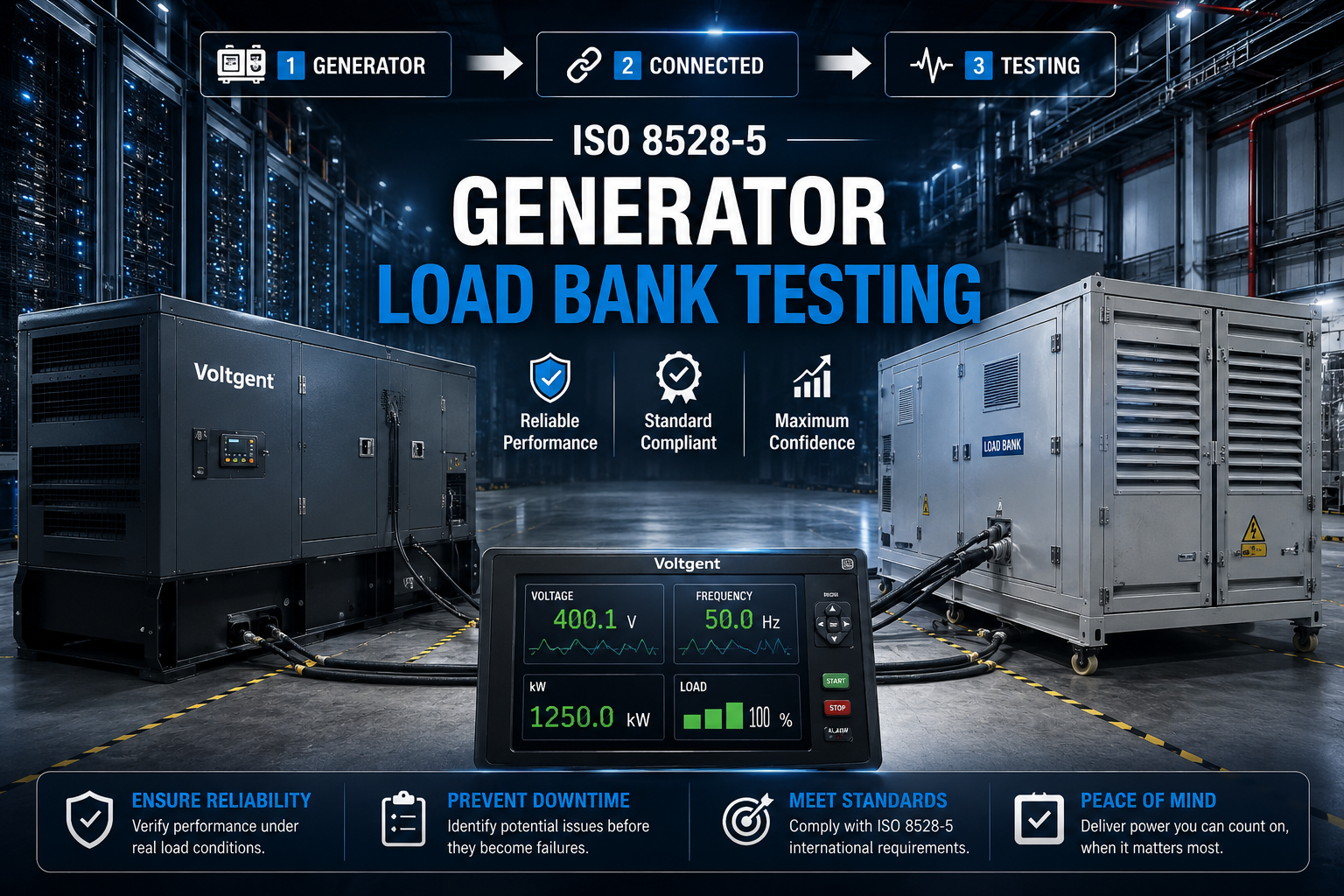
This is why Generator Load Bank Testing has become an important part of verifying generator performance.
What Is ISO 8528?
ISO 8528 is a series of international standards developed by the International Organization for Standardization (ISO) for:
Reciprocating Internal Combustion Engine Driven Alternating Current Generator Sets
ISO 8528-5 primarily focuses on the performance and dynamic response of generator sets.
In simple terms:
ISO 8528-5 is not only concerned with how much power a generator can produce. It also focuses on how stable the generator remains when the load changes.
Why Does a Generator Need Load Testing?
Many people assume:
“If the generator can start, there is no problem.”
But in real-world operation:
Starting ≠ Stable Power Supply
No-load operation ≠ Full-load Capability
Short-term operation ≠ Long-term Reliable Output
The real challenge for a generator comes when it faces sudden changes in electrical load, such as:
- Servers starting suddenly
- Motor starting currents
- UPS transfer
- Large power-consuming equipment being connected
These situations can cause rapid changes in generator loading.
A Load Bank allows engineers to artificially simulate these operating conditions and verify generator performance in a controlled environment.
What Performance Aspects Does ISO 8528-5 Focus On?
The core purpose of ISO 8528-5 is not simply to test power output. It is to evaluate the generator’s ability to respond to changing loads.
- Load Acceptance
When the load suddenly increases, for example:
50% Load → 100% Load
The generator needs to maintain:
- Stable voltage
- Stable frequency
- Stable engine speed
If the regulation capability is insufficient, the system may experience:
- Voltage dips
- Frequency fluctuations
- Unstable output
For critical facilities such as data centers, this could potentially result in:
- UPS abnormalities
- IT equipment protection shutdowns
- Failed system transfers
- Load Rejection
When a large amount of equipment suddenly stops operating, for example:
100% Load → 20% Load
The generator must also quickly return to a stable operating condition.
If the response is inadequate, the system may experience:
- Voltage overshoot
- Frequency overshoot
- Control system abnormalities
Therefore, load testing is not only about testing whether the generator can “take the load.”
It is also about testing whether the generator can “recover and stabilize.”
Key Generator Performance Tests Related to ISO 8528-5
| Test Item | Test Purpose | Role of the Load Bank |
| Steady-State Load Test | Verify rated power output capability | Provides a stable simulated load |
| Load Acceptance Test | Evaluate dynamic response capability | Simulates sudden load increases |
| Load Rejection Test | Evaluate recovery capability | Simulates sudden load reduction |
| Long-Duration Run Test | Verify continuous operating capability | Simulates actual operating cycles |
| Parameter Monitoring | Analyze generator operating condition | Records voltage, current, frequency and other data |
How Does a Load Bank Help Meet Testing Requirements?
A Load Bank is essentially a: Controllable, adjustable, and repeatable artificial load.
Compared with actual equipment loads, it offers several important advantages:
| Comparison | Actual Load | Load Bank |
| Load Level | Difficult to control precisely | Precisely controllable |
| Test Repeatability | Relatively low | High |
| Full-Load Testing | Higher operational risk | Controlled and safer |
| Data Recording | Often incomplete | Traceable and recordable |
| Standardized Testing | Difficult to implement | Easier to execute |
Therefore, load banks are important tools for:
- FAT (Factory Acceptance Test)
- SAT (Site Acceptance Test)
- Periodic Maintenance Testing
Why Can’t Actual Operating Loads Completely Replace Load Bank Testing?
Many projects ask:
“If the equipment is already operating on site, why do we still need a load bank?”
The reason is simple:
Actual loads cannot always be fully controlled.
For example, a data center’s IT load may only be at 60% today, while the test procedure may require a controlled sequence such as:
25% → 50% → 75% → 100%
This allows engineers to systematically verify generator performance at different load levels.
In addition:
- New data centers may not yet have sufficient IT load
- New equipment should not be exposed to unnecessary testing risks
- It is not practical to intentionally create real power failure scenarios
Therefore, professional testing often requires a simulated load.
Voltgent Load Testing Solutions
As a professional load testing equipment supplier, Voltgent is committed to helping customers complete the entire testing process, from equipment verification to project delivery.
Voltgent Load Bank Features
- Supports resistive, reactive, and resistive-reactive load testing
- Covers applications from 100 kW to MW-class systems
- High-precision load control
- Modular design for system expansion
- Real-time data acquisition and test report generation
Applications
Voltgent Load Banks are suitable for:
- Generator FAT testing
- Data center commissioning
- Industrial power system verification
- Site Acceptance Testing (SAT)
- Periodic maintenance testing
Conclusion
The core objective of ISO 8528-5 is not simply to prove that: “The generator can operate.”
It is to verify whether the generator can maintain stable and reliable output under changing electrical conditions.
Load bank testing simulates real operating conditions, allowing potential problems to be identified before delivery and risks to be controlled before the system enters service.
For critical power systems:Testing is not an additional cost. It is an investment in reliability.
Voltgent provides professional load testing solutions to help customers worldwide improve power system stability and ensure that every generator set can perform reliably under real-world operating conditions.
Voltgent — Professional Load Testing Solutions for Critical Power Systems.