

In generator, UPS, and energy storage system (ESS) testing, load banks are often treated as plug-and-play devices. However, neglecting routine maintenance can lead to accuracy drift, frequent failures, and even irreversible damage to core components.
Based on extensive industrial field experience, this article outlines the key principles of load bank maintenance and explains how Voltgent (vgloadbank) reduces maintenance risks through robust structural design.
Why Is Load Bank Maintenance Often Underestimated?
In most testing projects, attention is focused on the equipment under test rather than the testing tool itself. Operating continuously under high power, high heat, and high airflow conditions, an inadequately maintained load bank is prone to the following issues:
- Reduced cooling efficiency → overheating of power modules
- Loose electrical connections → localized temperature rise and unstable test results
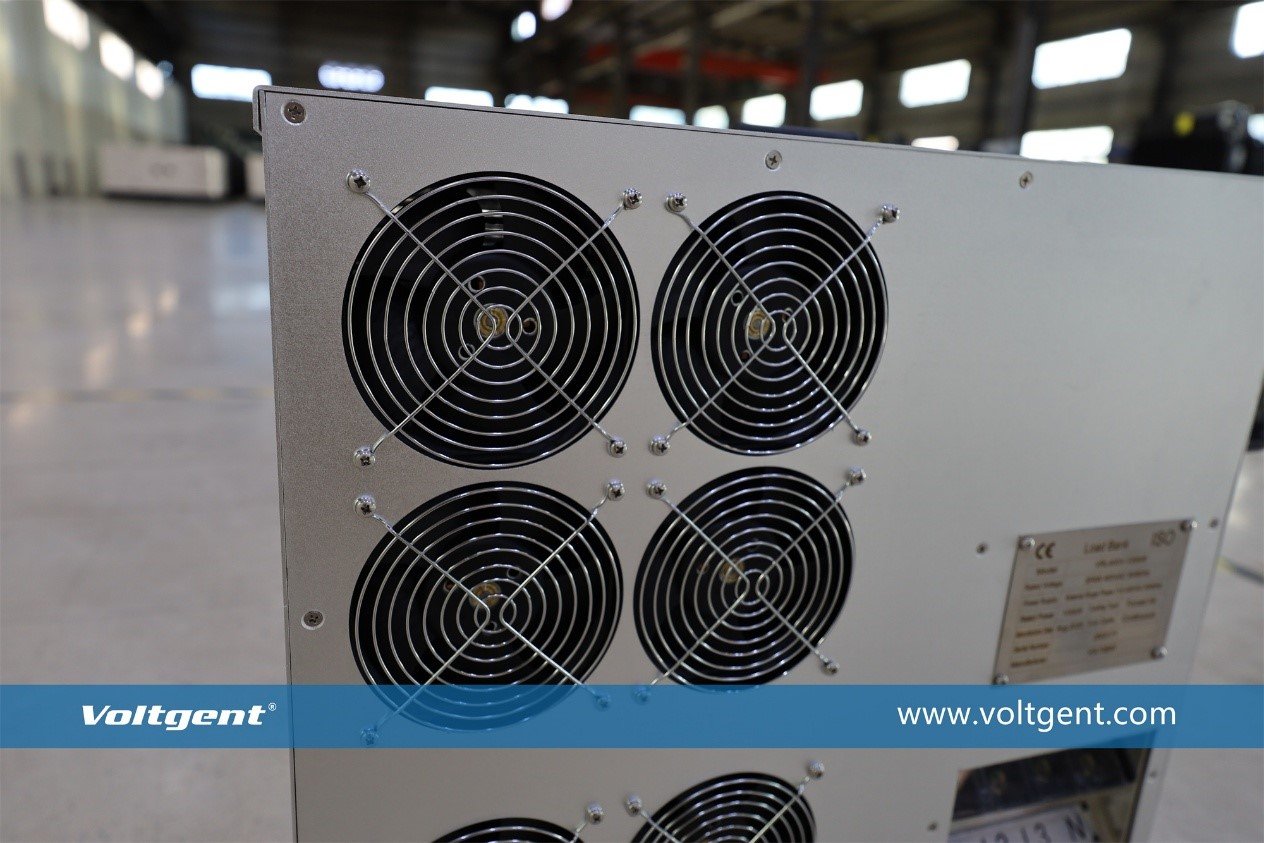
- Fan or cooling system failure → frequent protection trips and forced shutdowns
The conclusion is straightforward:
If the load bank is not properly maintained, the test results cannot be trusted.
Three Critical Areas of Routine Load Bank Maintenance
Load banks operate under sustained high current and high thermal stress. Routine maintenance directly determines their service life, accuracy, and operational stability.
Maintenance Overview
| Maintenance Item | Recommended Frequency | Key Focus | Risk if Neglected |
|
Air intake cleaning |
Every 200 operating hours |
Air filters, internal airflow channels |
Dust accumulation reduces cooling efficiency and causes long-term overheating of power elements |
|
Cooling system inspection |
Regular inspection |
Air-cooled: check fan operation and bearing condition (lubrication every 5,000 hours recommended) | Fan failure leads to cooling loss and system shutdown |
| Liquid-cooled: coolant concentration 40%–50% ethylene glycol; replace annually | Corrosion, scaling, and reduced heat transfer | ||
| Electrical connections & fastening |
Periodic |
Torque-check all terminals with a torque wrench | Increased contact resistance and localized overheating |
Voltgent Load Bank Advantages
- Reinforced structural design at critical power connection points
- Optimized for frequent transportation and repeated testing applications
Common Load Bank Maintenance Mistakes
| Common Mistake | Potential Risk | Best Practice |
| Relying solely on protection functions | Premature aging of core components | Strictly follow derating curves |
| Ignoring ambient temperature | Damage under extreme cold or heat | Use wide-temperature models (-40°C to +85°C) or enable preheating |
| “Fix it when it fails” maintenance | Unexpected downtime | Implement planned preventive maintenance |
| Only performing zero-point calibration | Severe full-range accuracy deviation | Conduct multi-point calibration from 0–100% |
The Future of Load Bank Maintenance: Digital and Predictive Approaches
With the advancement of industrial digitalization, load bank maintenance is rapidly evolving.
Predictive Maintenance
- Sensor networks: Real-time health monitoring using vibration, temperature, and current sensors
- AI diagnostic models: LSTM-based algorithms trained on historical data to predict remaining power module life with accuracy exceeding 90%
Remote Calibration and Data Compliance
- Remote calibration: Cross-regional calibration via 4G/5G networks using standard reference sources
- Blockchain-based certification: Calibration records stored on blockchain to ensure data integrity and compliance with ISO/IEC 17025
Voltgent Load Bank Design for Long-Term Reliability
Voltgent load banks are engineered from the design stage for continuous operation and on-site maintainability:
- Modular architecture to minimize maintenance downtime
- Industrial-grade airflow design suitable for high-dust environments
- Ideal for high-frequency testing of generators, UPS systems, energy storage systems, and data centers
Conclusion
Load bank maintenance and calibration are not optional tasks—they are essential to test accuracy, operational reliability, and long-term cost control. By implementing standardized maintenance procedures and disciplined calibration management, organizations can significantly reduce failure rates and extend equipment lifespan.
In an era of increasingly stringent testing requirements, treating load banks as long-term assets rather than consumables is the key to achieving efficient testing and sustainable cost performance.