

Many companies regularly maintain their diesel generators but overlook another equally important piece of equipment: the load bank.
A load bank is more than a large electrical resistor. It is a professional power testing system integrating resistive load elements, cooling fans, control systems, measurement instruments, and safety protection devices.
Load banks are widely used for testing diesel generators, UPS systems, energy storage systems, data centers, electrical equipment, and marine power systems.
During operation, a load bank may continuously absorb hundreds or even thousands of kilowatts of electrical power, converting almost all of it into heat. This means it operates under demanding conditions involving high currents, elevated temperatures, forced-air cooling, and sometimes harsh outdoor environments.
Without proper maintenance, a load bank may suffer from reduced testing accuracy, overheating, frequent protection trips, fan failures, or unreliable test results.
This is why preventive maintenance is just as important for load banks as it is for diesel generators.
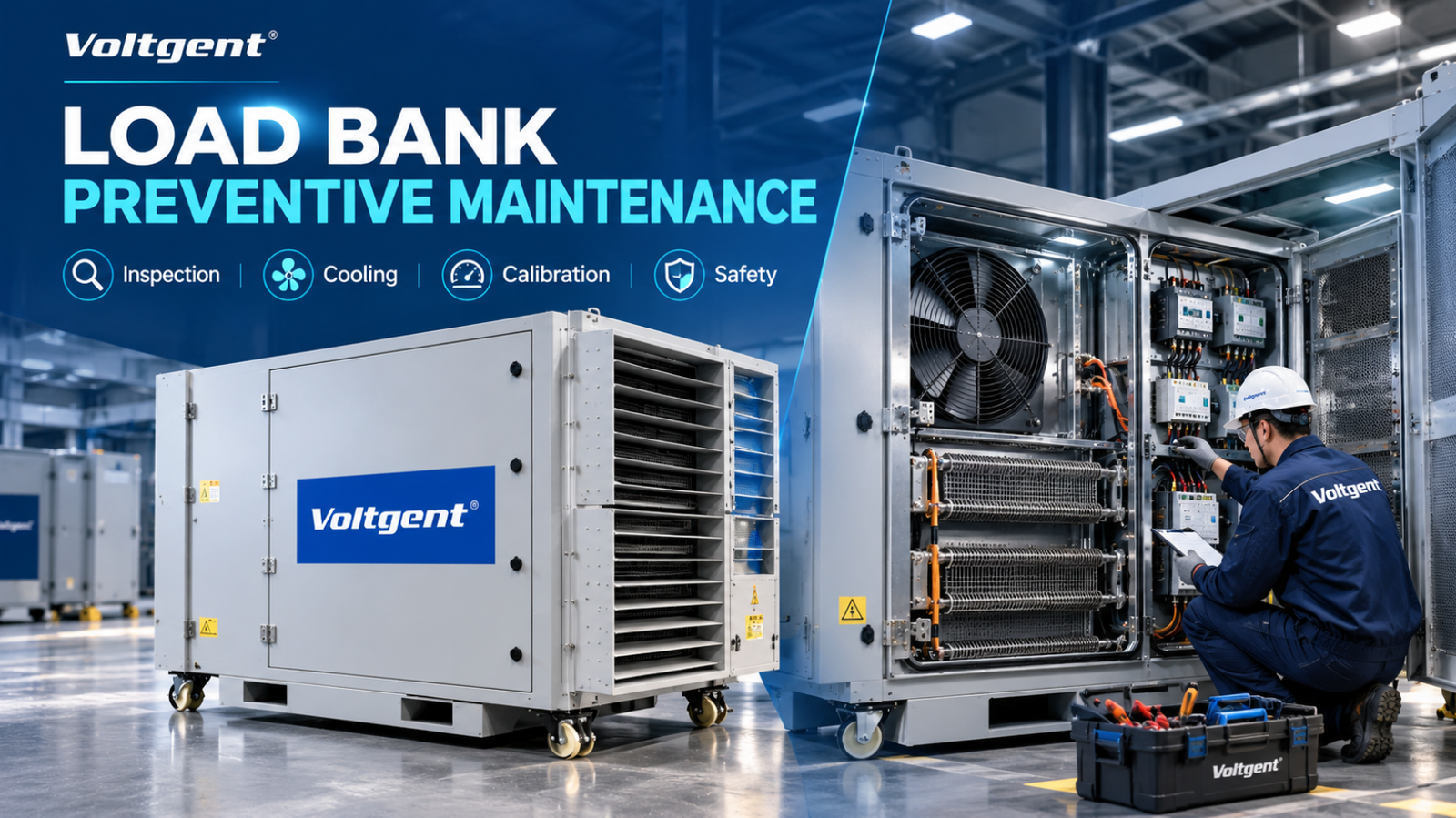
Why Do Load Banks Need Maintenance?
Different operating environments create different maintenance challenges.
| Operating Condition | Potential Impact on the Load Bank |
| Continuous high-load operation | Prolonged high temperatures can accelerate resistor aging |
| Outdoor construction sites | Dust, sand, and moisture may enter the enclosure and restrict airflow |
| Coastal or port environments | Salt-laden air may corrode terminals, busbars, and fasteners |
| Extended periods of inactivity | Moisture accumulation may reduce insulation resistance and increase electrical fault risks |
| Frequent testing cycles | Contactors, relays, and other switching components gradually wear out |
Although load banks have fewer mechanical components than diesel engines, they are still industrial electrical equipment.
A structured maintenance program is essential for ensuring long-term reliability, safety, and consistent testing performance.
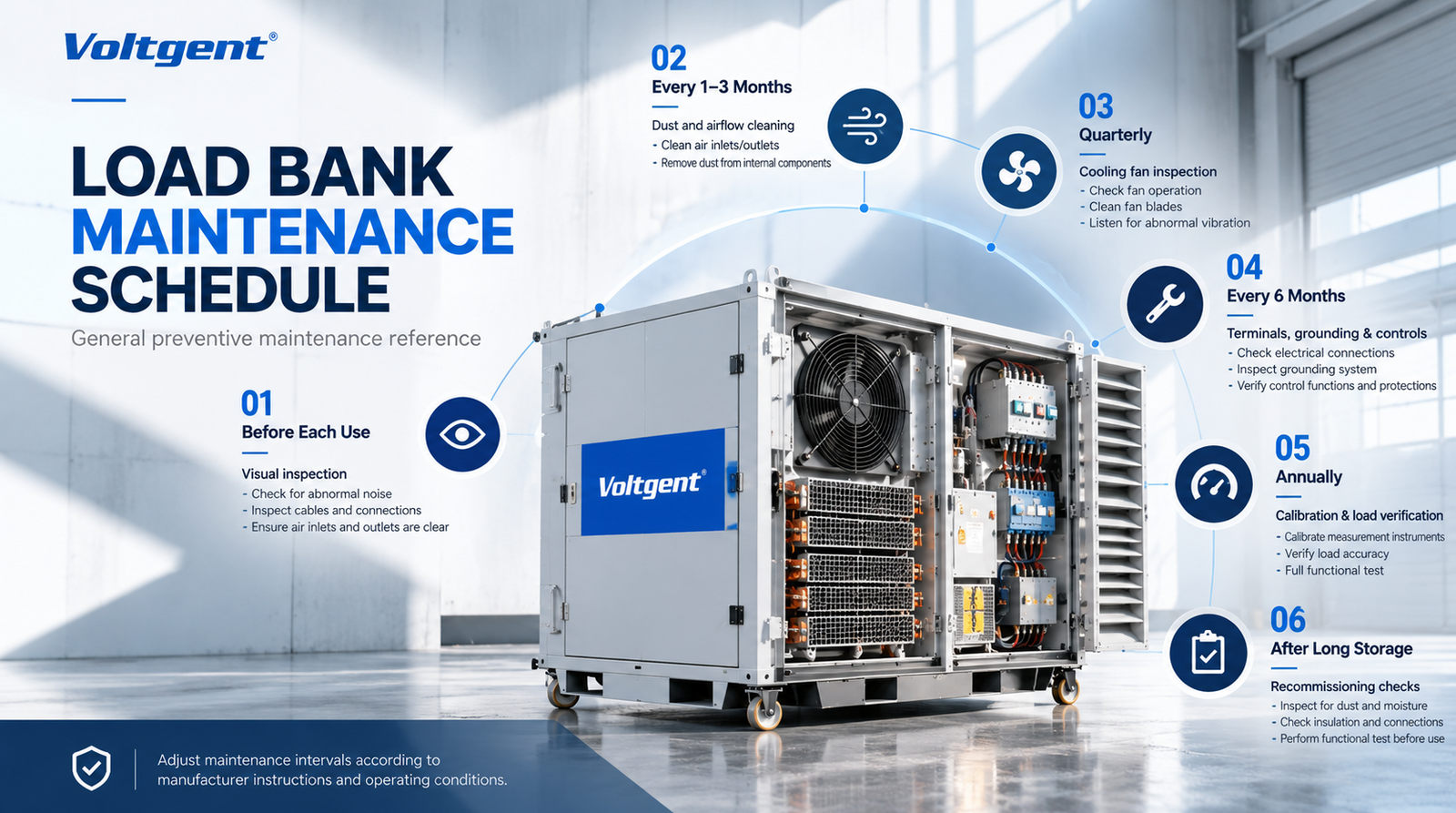
Load Bank Preventive Maintenance Checklist
The following checklist provides general maintenance recommendations. Actual intervals should be adjusted according to the manufacturer’s instructions, operating hours, environmental conditions, and application requirements.
| Inspection Item | Recommended Frequency | Key Inspection Points |
| Visual inspection | Before each use | Check the enclosure, door locks, lifting points, and casters for damage |
| Dust cleaning | Every 1–3 months | Remove dust from resistor elements, fans, ventilation openings, and airflow passages |
| Cooling fan inspection | Quarterly | Check fan operation, abnormal noise, and airflow or pressure switches |
| Electrical terminal inspection | Every 6 months | Check for loose connections and signs of localized overheating |
| Grounding inspection | Every 6 months | Verify protective earthing connections |
| Control system inspection | Every 6 months | Test emergency stops, alarms, and protective functions |
| Instrument calibration | Every 12 months | Verify voltage, current, power, and frequency measurements |
| Load capacity verification | Every 12 months | Confirm actual load performance against rated values under specified test conditions |
A standardized maintenance routine helps extend equipment service life while ensuring that test results remain reliable.
Five Commonly Overlooked Load Bank Maintenance Tasks
3.1 Dust Accumulation: A Small Problem with Serious Consequences
Not every load bank failure is caused by a damaged electrical component.
Sometimes, the problem is simply dust.
Over time, dust can accumulate on:
- Resistive elements
- Cooling fan blades
- Ventilation openings
- Internal airflow passages
As airflow becomes restricted, internal temperatures rise. In severe cases, this can trigger over-temperature protection or damage internal components.
Maintenance tip: Clean the equipment periodically using suitable dry compressed air or a soft brush, following the manufacturer’s instructions.
Avoid directing high-pressure water into the enclosure or electrical components.
3.2 Cooling Fans: Essential for Load Bank Reliability
Resistors are often considered the most important components of a load bank.
However, the cooling system is equally critical to safe operation.
In a resistive load bank, nearly all absorbed electrical power is converted into heat.
If the cooling fans cannot deliver sufficient airflow, resistor temperatures may rise rapidly.
Key inspection points include:
- Is the fan operating at the correct speed?
- Is there any unusual noise or vibration?
- Are airflow or pressure switches functioning correctly?
- Are ventilation passages blocked?
A cooling fan failure can cause the entire load bank to shut down, even when the resistive elements themselves remain functional.
Maintenance tip: Never bypass airflow protection devices or continue loading when the cooling system is malfunctioning.
3.3 Long-Term Storage Can Create Unexpected Problems
It is easy to assume that equipment will remain in good condition if it is rarely used.
However, extended storage can introduce several risks:
- Moisture accumulation
- Oxidation of copper busbars and terminals
- Reduced insulation resistance
- Moisture damage to control circuit boards
For equipment kept in storage, a monthly inspection and functional check is a useful preventive practice.
Where permitted by the manufacturer, operate the cooling fans without applying electrical load to verify their condition.
However, fan-only operation does not necessarily remove internal moisture, because the resistive elements are not generating significant heat.
If moisture is suspected, inspect insulation resistance and follow the manufacturer’s approved drying or recommissioning procedure before applying load.
3.4 Electrical Connections Need Periodic Inspection
Load banks experience repeated heating and cooling cycles during operation.
Over time, thermal expansion and contraction may contribute to loosening at electrical connections.
Increased contact resistance can cause:
- Localized overheating
- Voltage drops
- Abnormal load performance
- Damaged or burned terminals
Maintenance tip: Inspect main circuit connections approximately every six months, or more frequently in demanding applications.
All inspection and tightening work must be performed by qualified personnel with the equipment safely isolated, locked out, and verified de-energized.
Use the manufacturer’s specified tightening torque rather than tightening connections indiscriminately.
3.5 Measurement Instruments Also Need Calibration
A load bank that can still apply electrical load is not necessarily measuring it accurately.
For professional testing, measurement accuracy is one of the most important aspects of load bank performance.
Over time, measurement deviations may develop in components such as:
- Current transformers (CTs)
- Voltage sensing modules
- Power measurement modules
For example, consider a load bank rated at 1,000 kW.
If it delivers only 960 kW under the specified rated-voltage conditions, the discrepancy could affect the interpretation of a generator performance test.
However, it is important to distinguish between actual load capacity and displayed measurement accuracy. Resistive load output also depends on the applied voltage.
Maintenance tip: For generator manufacturers, third-party testing companies, and data center operators, annual calibration and load performance verification are recommended starting points.
How to Recommission a Load Bank After Long-Term Storage
If a load bank has not been operated for an extended period, it should be inspected before returning to service.
A general recommissioning procedure is outlined below.
| Step | Inspection or Test |
| Step 1 | Inspect the enclosure for physical damage, corrosion, or moisture |
| Step 2 | Verify all protective grounding connections |
| Step 3 | Inspect cooling fans and ventilation passages |
| Step 4 | Check test cables, connectors, and electrical terminals |
| Step 5 | Run the cooling system without applying load for approximately 10 minutes, if supported by the equipment |
| Step 6 | Gradually apply load at 25%, 50%, 75%, and 100% of the intended test level |
| Step 7 | Confirm that operating parameters and protection functions are normal before returning the equipment to regular service |
Before energizing equipment that has been stored in damp conditions, insulation resistance and electrical safety should be verified according to the manufacturer’s procedures.
Gradual loading helps confirm equipment performance and identify potential faults before a full-load test.
The loading sequence must remain within the load bank’s rated voltage, current, power, and cooling limits.
Common Load Bank Problems and Troubleshooting
The following table summarizes common operating problems and their possible causes.
| Problem | Possible Cause | Recommended Action |
| Load bank will not start | Auxiliary power is disconnected | Check the auxiliary power supply and wiring |
| Equipment stops shortly after starting | Supply voltage abnormality or protection trip | Check supply voltage and alarm messages |
| Cooling fan does not run | Fan failure or power supply problem | Inspect the fan and its supply circuit |
| Insufficient airflow | Blocked ventilation openings | Clean the fan and airflow passages |
| High-temperature alarm | Inadequate cooling | Check fans, airflow switches, and ambient temperature |
| Load disconnects immediately after switching on | Emergency stop activated or protection interlock engaged | Identify the fault and reset the equipment only after it has been resolved |
| Actual load power is below the set value | Low test voltage, loose cables, or load circuit problems | Check input voltage, test cables, and load connections |
| Software communication failure | Incorrect communication cable, address, or settings | Check communication interfaces and configuration parameters |
| Abnormal instrument readings | Measurement module deviation or fault | Inspect the measurement circuit and arrange recalibration if necessary |
Safety reminder: Troubleshooting involving internal electrical components should be carried out only by qualified personnel. Always isolate electrical supplies before opening the enclosure or servicing internal components.
Why Is Regular Load Bank Calibration Important?
For professional electrical testing, a load bank must do more than apply load.
It must also provide accurate and repeatable test conditions.
Generator factory acceptance testing, data center commissioning, and electrical power system testing often require reliable measurement records.
Over time, electronic component aging, environmental exposure, and measurement system drift may affect accuracy.
Recommended practices include:
- Perform metrological calibration approximately once every 12 months.
- Verify voltage, current, power, and power factor measurements where applicable.
- Compare readings against suitable calibrated reference instruments when necessary.
For purely resistive load banks, power factor is normally close to unity under appropriate operating conditions. Power factor verification is particularly relevant for resistive-reactive load banks.
It is also important to distinguish between instrument calibration and load capacity verification.
Instrument calibration checks whether the measurement system reports electrical values correctly.
Load capacity verification checks whether the equipment applies the expected electrical load under defined voltage and operating conditions.
Both are important for dependable test results.
Regular calibration improves confidence in test data and helps support customer acceptance testing and third-party inspection requirements.
Why an Annual Maintenance Plan Is Better Than Reactive Repairs
For load banks used in generator testing, data centers, UPS systems, battery energy storage systems, and marine applications, maintenance should not begin only after a failure occurs.
A structured annual preventive maintenance program helps reduce:
- Measurement errors
- Unexpected downtime
- Component damage
- Repair costs
- Project delays
For equipment used frequently or under demanding operating conditions, preventive maintenance can be significantly more cost-effective than dealing with unexpected failures during critical testing.
Voltgent: Keeping Your Load Bank Reliable and Ready for Testing
A reliable load bank requires more than robust equipment design. Proper maintenance and operating practices are equally important.
Voltgent provides resistive, reactive, and resistive-reactive load bank solutions for a wide range of power testing applications.
We also support customers with equipment commissioning, maintenance recommendations, calibration guidance, remote technical assistance, and ongoing service support.
Our goal is to help customers maintain safe operation, dependable performance, and consistent testing accuracy throughout the equipment’s service life.
Whether your application involves generator manufacturing, data centers, power systems, marine installations, energy storage, or rental fleets, Voltgent can help you select and maintain the right load bank testing solution for your project.
For more information, visit https://vgloadbank.com/.
FAQ
Q1. How often should a load bank be maintained?
A visual inspection is recommended before each use, cooling system inspections should generally be performed quarterly, and comprehensive maintenance and instrument calibration should typically be scheduled annually. Actual intervals depend on operating conditions and manufacturer recommendations.
Q2. Can a load bank deteriorate during long-term storage?
Yes. Extended inactivity may lead to moisture accumulation, reduced insulation resistance, and oxidation of electrical connections. Monthly inspections and suitable functional checks are recommended for stored equipment.
Q3. Why does a load bank need calibration?
Voltage, current, and power measurement systems may drift over time. Regular calibration helps maintain accurate, reliable, and repeatable test results.
Q4. Can a load bank operate with a faulty cooling fan?
No. The cooling system is essential for safe operation. Continuing to apply load with a malfunctioning fan may cause overheating and damage the resistive elements.
Q5. How do I know when a load bank needs cleaning?
Common warning signs include reduced airflow, frequent high-temperature alarms, visible dust around ventilation openings, or significant dust accumulation inside the enclosure. Cleaning should be carried out according to the manufacturer’s maintenance instructions.