

A 1,000 kW resistive load bank is running at full load.
The cooling fans are operating, air is flowing through the resistive elements, and hot air is being discharged through the exhaust. Everything appears to be working normally.
Then, suddenly, a cooling fan stops.
The load bank is still connected to the generator. If the full 1,000 kW load remains applied, electrical energy continues to be converted into heat, but the airflow needed to remove that heat has been lost.
So what stops the resistive elements from continuing to heat up?
The answer is not the fan itself. It is the protection logic built into the load bank.
In load banks equipped with appropriate safety interlocks, the control system can disconnect the resistive load when abnormal cooling conditions are detected, helping prevent the equipment from operating without sufficient heat dissipation.
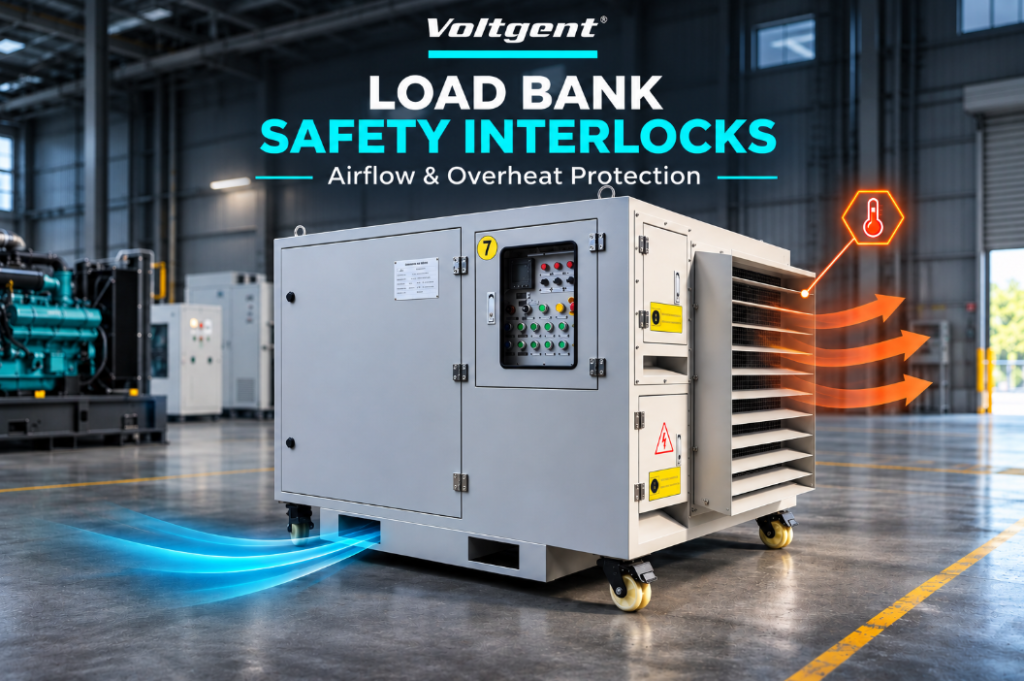
The Fan Is Running. So Why Could the Load Bank Still Overheat?
Here is something that is easy to overlook:
A running fan does not necessarily mean sufficient airflow.
Think about a hair dryer with its air intake partially blocked. The motor may still be running, but much less air is passing through the appliance.
A load bank can face a similar problem.
For example, an air intake louver might become covered by a plastic sheet, equipment may be placed too close to the exhaust outlet, or a fan impeller could become damaged.
In these situations, even if the control system receives a signal confirming that the fan motor is running, it cannot necessarily assume that cooling is adequate.
That is why some industrial load banks use an airflow switch or air pressure switch to help verify cooling conditions.
These devices act as an additional checkpoint.
If the required conditions are met, loading can be permitted. If they are not, the control system may prevent loading or initiate a protective shutdown.
However, an air pressure switch detects pressure conditions at a particular location. It does not directly measure the total airflow through the entire cooling system.
If the Load Bank Overheats, Why Not Just Shut Everything Down?
Because stopping heat generation and removing existing heat are two different things.
Even after electrical power to the resistive elements is disconnected, the elements and surrounding structures do not cool down instantly.
Think of an electric oven that has just been switched off. The heating elements are no longer powered, but the inside remains hot for some time.
The same principle applies to a resistive load bank.
In some protection designs, an overtemperature alarm causes the system to disconnect the resistive load while allowing the cooling fans to continue operating for a period of time.
This helps remove residual heat from inside the equipment.
Of course, the response depends on the type of fault. If the fan itself has failed, the system cannot rely on that fan to provide continued cooling.
A safety interlock is therefore not simply an instruction to switch everything off. It is part of a control system designed to respond appropriately to different abnormal conditions.
The exact protection sequence depends on the equipment design.
What Actually Tells the Load Bank to Stop Loading?
It helps to think of the protection system as three parts working together.
| Role | Typical Components | What They Do |
|---|---|---|
| Detect a problem | Airflow switches, air pressure switches, temperature protection devices | Identify abnormal cooling or temperature conditions |
| Make a decision | Control circuit or controller | Determine whether loading is permitted |
| Take action | Load contactors | Connect or disconnect the resistive load circuits |
For example, when a temperature protection device detects excessive heat, it can send a signal to the control system.
The control system may then remove the loading permission, causing the relevant load contactors to open.
Once the resistive load is disconnected, it no longer draws the previously applied load power from the generator.
This is the basic principle behind a load bank safety interlock.
Different manufacturers may use different monitoring devices and control arrangements, so not every load bank includes all the components described above.
For more information about industrial control components and electrical protection, see the Schneider Electric Technical Resources Center.
The Alarm Has Been Reset. Why Can’t Testing Simply Continue?
Imagine that a load bank suddenly displays an Airflow Fault during a generator test.
The operator checks the control panel, resets the alarm and applies the load again.
A few minutes later, the same alarm appears.
The problem may not be with the alarm system at all.
A blocked air intake, restricted exhaust path or faulty cooling fan could be causing the protection system to respond repeatedly.
Simply resetting the alarm does not correct the underlying problem.
Worse still, bypassing an airflow switch or another protective device to force the load bank to operate could expose the equipment to unsafe temperatures.
The correct approach is to identify the cause, inspect the cooling system and relevant protection devices, and restore operation according to the manufacturer’s maintenance procedures.
For further reading on electrical testing, maintenance and troubleshooting, visit Fluke’s Technical Learning Resources.
One Often-Overlooked Detail: Safety Devices Need Maintenance Too
The value of a safety interlock often becomes apparent only when something goes wrong.
But what if the airflow switch fails?
What if a temperature protection device is faulty, or a contactor does not open when commanded?
In these situations, the protection system may not respond as intended.
That is why routine maintenance should go beyond checking whether the cooling fans are spinning.
Relevant sensors, switching components and protective functions should also be inspected or tested according to the equipment manufacturer’s instructions.
For a forced-air-cooled resistive load bank, the important question is not only how much electrical load it can apply.
It is also whether the equipment can respond appropriately when cooling conditions become unsafe.
A well-designed protection system cannot prevent every failure. Its purpose is to help prevent an abnormal condition from developing into a more serious problem.
FAQ: Load Bank Safety Interlocks
Q1. What is a load bank safety interlock?
A load bank safety interlock is a control mechanism that prevents loading or initiates other protective actions when specified safety conditions are not met.
Q2. Does a running cooling fan guarantee sufficient airflow?
No. Even when the fan motor is running, blocked air intakes, restricted ventilation paths or damaged fan components can reduce cooling airflow.
Q3. What happens when a load bank overheats?
In load banks equipped with appropriate protection, overheating may trigger an alarm, prevent further loading or disconnect the resistive load. Some systems also keep the cooling fans running after unloading to remove residual heat.
Q4. Can an airflow switch be bypassed to continue testing?
No. Bypassing a protective device can allow the load bank to operate under unsafe cooling conditions. The fault should be investigated and corrected before testing resumes, following the manufacturer’s instructions.