

Although hydrogen fuel cells do not have mechanical components such as diesel engines, they still require load testing to verify power output capability, dynamic response, polarization curves, and overall system reliability.
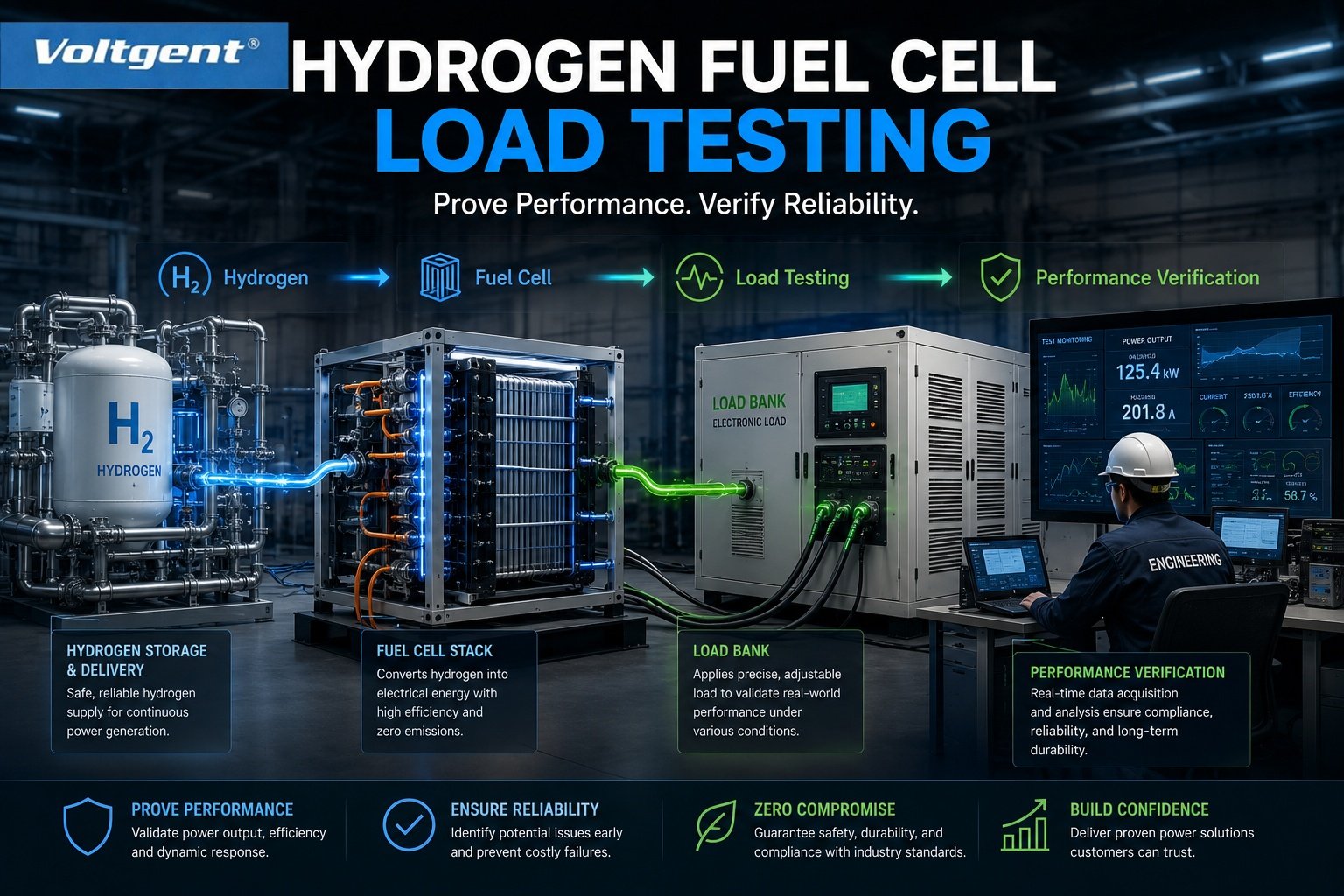
With the development of green hydrogen, data centers, and microgrids, load testing has become an essential part of fuel cell R&D, production testing, acceptance testing, and operation and maintenance.
From Diesel Generators to Hydrogen Fuel Cells: Backup Power Is Changing
Driven by global carbon neutrality targets, backup power systems are undergoing another major technological transformation.
In the past, hospitals, data centers, ports, telecommunications sites, and industrial facilities primarily relied on diesel generators for backup power.
Today, however, an increasing number of projects are exploring hydrogen fuel cells as a cleaner and more efficient energy solution.
Compared with diesel generators, hydrogen fuel cells offer several advantages:
- Zero carbon emissions at the point of use, with water as the primary by-product
- Low operating noise
- High electrical efficiency
- Suitable for long-duration backup power
- Better aligned with global and European clean energy policies
According to the International Energy Agency (IEA) Global Hydrogen Review and the European Union’s Hydrogen Strategy for a Climate-Neutral Europe, hydrogen is expected to play an important role in future energy systems. Data centers, ports, and large industrial facilities are actively exploring fuel cell-based backup power solutions.
However, many people may ask:
“If a fuel cell does not have an engine, does it still need load testing?”
The answer is exactly the opposite.
As new energy technologies develop, load testing is becoming more important—not less.
Why Do Hydrogen Fuel Cells Also Need Load Testing?
A diesel generator needs to verify whether its engine and alternator can operate reliably under load.
A fuel cell does not rely on a complex mechanical powertrain, but it still needs to verify the performance of its entire electrochemical power generation system.
Load testing helps engineers determine whether a fuel cell system can provide stable, safe, and reliable electrical power under different operating conditions.
Key Areas Verified During Fuel Cell Load Testing
| Test Objective | Why It Needs to Be Tested |
| Power Output Verification | Confirm that the rated power meets the design requirements |
| Dynamic Response | Simulate rapid load changes and verify system response speed |
| Polarization Curve Testing | Analyze voltage variation and efficiency at different current levels |
| Durability Testing | Verify performance degradation during long-term operation |
| Control System Verification | Check the stability of DC/DC converters, power management, and control strategies |
Simply put:
Load testing is not only about measuring how much power a fuel cell can produce. It is about verifying whether the entire fuel cell system can operate reliably over time.
How Is Fuel Cell Testing Different from Diesel Generator Testing?
Although both systems can be used for backup power, their testing priorities are quite different.
| Comparison | Diesel Generator | Hydrogen Fuel Cell |
| Power Generation Principle | Internal combustion engine drives an alternator | Electrochemical reaction directly generates electricity |
| Typical Output | AC power | Primarily DC power, with an inverter used for AC output in some systems |
| Testing Focus | Engine and AC power generation system | Fuel cell stack, DC/DC converter, and control system |
| Key Parameters | Load capability, engine performance, combustion efficiency | Polarization curve, dynamic response, and output stability |
| Typical Test Equipment | AC Load Bank | DC Electronic Load / Regenerative Load |
| Dynamic Loading | Recommended / required depending on the test | Essential for system performance verification |
| Durability Testing | Yes | Yes |
As shown above, although the test targets are different:
Load testing remains a core method for performance verification.
What Is a Polarization Curve and Why Is It So Important?
For fuel cells, the Polarization Curve is one of the most important indicators used to evaluate system performance.
By gradually increasing the load, the test system records:
- Output voltage
- Output current
- Output power
- Electrical efficiency
The resulting data can be used to generate a polarization curve, which helps engineers analyze fuel cell performance under different operating conditions.
Engineers can use the polarization curve to determine:
- Whether the system reaches its rated power
- Whether performance degradation is occurring
- Whether abnormal voltage drops are present
- Whether control strategies need to be optimized
Therefore, polarization curve testing is an important part of fuel cell R&D, factory testing, and performance evaluation.
Why Do Fuel Cell Systems Place Higher Demands on Test Equipment?
Compared with conventional diesel generators, fuel cells have more complex electrical output characteristics. As a result, the test equipment must provide higher levels of precision and control.
① Low Voltage and High Current Output
The voltage of a single fuel cell is typically below 1 V.
Even when multiple cells are assembled into a stack, system output voltages may commonly include:
- 48 V
- 60 V
- 120 V
- 240 V
When the system operates at higher power levels, the voltage can decrease significantly while the current increases substantially.
Therefore, test equipment must be capable of safely and stably absorbing hundreds or even thousands of amperes at relatively low voltage levels.
② Fast Dynamic Response
In real-world applications, electrical loads do not remain constant.
For example:
- Data center servers starting up
- Port equipment starting and stopping
- Grid power fluctuations
- Vehicle acceleration
can all cause rapid changes in electrical demand.
Therefore, modern electronic loads need to provide millisecond-level dynamic response to accurately simulate real operating conditions.
③ Regenerative Energy Recovery for More Efficient Testing
Traditional resistive Load Banks convert the tested electrical energy into heat, which requires substantial heat dissipation capacity.
Modern fuel cell testing increasingly uses Regenerative Electronic Loads.
Key advantages include:
- Feeding test energy back into the facility grid
- Reducing energy waste
- Reducing cooling requirements
- Improving overall testing efficiency
- Supporting greener manufacturing practices
For long-duration R&D testing, regenerative systems can significantly reduce operating costs.
Which Industries Are Starting to Use Fuel Cell Load Testing?
With the continued development of the hydrogen energy industry, fuel cell testing is being applied across multiple sectors:
- Data center backup power
- Ports and shore power systems
- Telecommunications base stations
- Microgrids
- Energy storage systems
- Hydrogen-powered buses and commercial vehicles
- Ground support equipment for aviation
- Research laboratories and universities
These industries are concerned not only with power output, but also with long-term system stability and reliability.
As a result, demand for high-precision fuel cell test equipment continues to grow.
In the New Energy Era, Load Testing Is Becoming More Important
Some people believe that as renewable energy technologies develop, traditional Load Banks will gradually disappear.
The reality is quite different.
From diesel generators to fuel cells, energy storage systems, and microgrids:
Load testing remains a critical method for verifying equipment performance and ensuring system reliability.
What is changing is the technology used for testing.
| Traditional Testing | New Energy Testing |
| AC Resistive Load Bank | DC Electronic Load |
| Electrical energy converted entirely into heat | Energy recovered back to the grid |
| Fixed loading | Dynamic programmable loading |
| Manual control | Automated data acquisition |
| Basic performance verification | Full lifecycle performance evaluation |
Looking ahead, load testing equipment will become increasingly intelligent, efficient, and integrated with digital technologies and green energy systems.
Voltgent: Professional Load Testing Solutions for the Future of Energy
As energy systems continue to evolve, Voltgent continues to monitor developments in load testing technology and provides professional load testing solutions for customers worldwide.
Voltgent can provide:
- AC Resistive Load Banks
- Resistive-Inductive Load Banks (R-L)
- High-Voltage Load Testing Solutions
- Customized High-Power Load Systems
- Data Acquisition and Automated Test Reporting
These solutions are widely applicable to:
- Generator Factory Acceptance Testing (FAT)
- Site Acceptance Testing (SAT)
- Data Center Commissioning
- UPS System Verification
- Industrial Power System Maintenance
Looking ahead, as hydrogen, energy storage, and other new energy technologies continue to develop, Voltgent will continue to follow advances in electronic loads, regenerative loads, and other next-generation testing technologies, providing customers with more accurate, efficient, and sustainable testing solutions.
From conventional diesel generators to hydrogen fuel cells, energy technologies continue to evolve.
But one thing remains unchanged:
Any power source must be scientifically and accurately load tested before its reliability can truly be proven.
For hydrogen fuel cells, load testing is not only an important tool for product development, but also a critical part of ensuring safe operation, improving performance, and meeting project acceptance requirements.
As the green energy era continues to develop, load testing technology will not become obsolete.
Instead, it will play an increasingly important role in new energy R&D, manufacturing, commissioning, and real-world applications.
FAQ
Q1: Why do hydrogen fuel cells need load testing?
Load testing can verify the fuel cell’s power output capability, dynamic response, polarization curve, and long-term operating reliability. It is an essential part of fuel cell R&D, production testing, and acceptance testing.
Q2: Should traditional Load Banks or electronic loads be used for fuel cell testing?
AC power generation systems typically use AC Load Banks, while fuel cells primarily produce DC power.
Therefore, fuel cell systems generally use DC Electronic Loads or Regenerative Electronic Loads to achieve higher testing precision and, where applicable, energy recovery.
Q3: What is a fuel cell Polarization Curve?
A Polarization Curve describes how the fuel cell voltage changes with current under different operating conditions.
It is an important reference for evaluating efficiency, system health, and design performance, and is one of the key indicators in fuel cell testing.
Q4: Why does fuel cell testing require dynamic loading?
Loads in real applications constantly change.
Examples include server startup, equipment cycling, and grid fluctuations.
Dynamic loading allows engineers to simulate these real-world conditions and verify the transient response and control strategy of the fuel cell system.
Q5: What is the future trend of load testing technology?
With the development of hydrogen, energy storage, and microgrids, load testing is evolving from traditional resistive Load Banks toward electronic loads, regenerative loads, and intelligent automated testing platforms.
These technologies enable higher testing accuracy, lower energy consumption, and more comprehensive performance analysis.