

In hospitals, data centers, industrial parks, and emergency power systems, generators are often regarded as the “last line of defense.”
However, in practice, a generator that can start is not necessarily a reliable generator.
Only through proper and comprehensive generator load testing can you verify whether a generator is capable of delivering stable and continuous power under real operating conditions. This is the core value of load bank testing.
As a professional load bank and testing solution provider, Voltgent leverages extensive field experience to help you understand:
- Why generator load testing is necessary
- What the standard testing procedure is
- How load testing helps prevent critical risks
1.What Is Generator Load Testing?
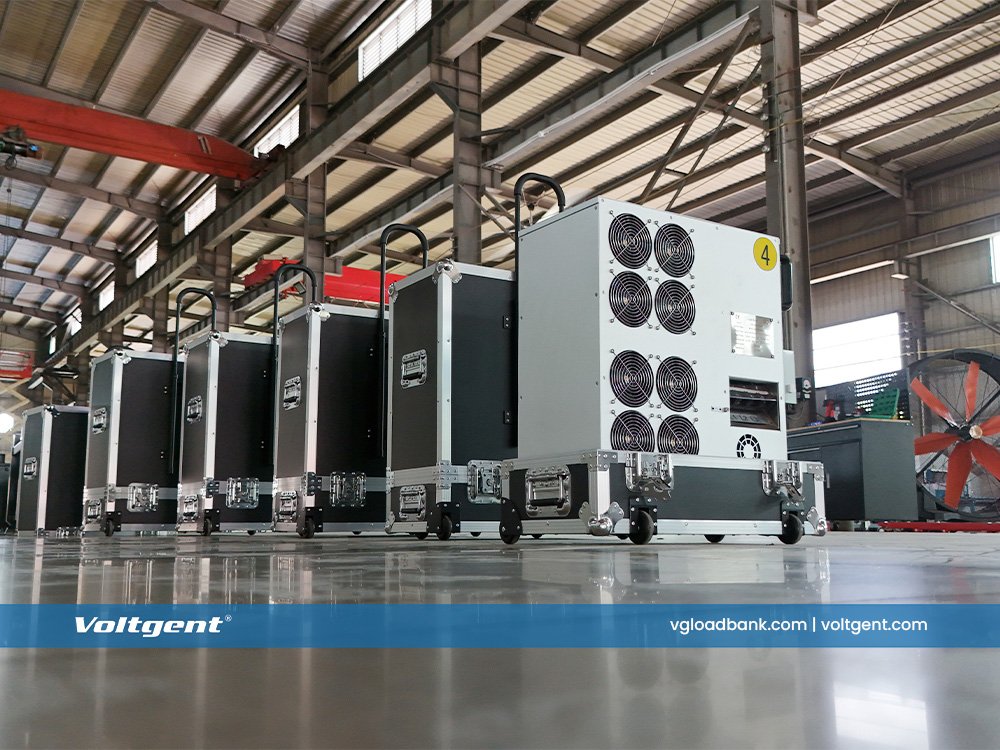
Generator load testing is a controlled “stress test” performed using a load bank to simulate real power demand, allowing evaluation of generator performance under different load conditions.
Unlike simple no-load startup, load testing focuses on:
- Whether the generator can deliver rated kW output
- Stability of voltage and frequency
- Reliability of cooling, fuel, and exhaust systems
- Detection of hidden issues such as wet stacking
Key Performance Indicators
| Test Item | Verification Focus |
| Power Output | Ability to reach and sustain rated kW |
| Voltage Stability | Fluctuation under load changes |
| Frequency Response | Speed of recovery to stable frequency |
| Thermal Performance | Adequacy of cooling system |
| Exhaust & Combustion | Presence of carbon buildup or wet stacking |
2.Why Is Generator Load Testing Necessary?
In many real-world projects, generators operate under light load or standby conditions for extended periods.
When a real power outage occurs, hidden issues may only become apparent—often too late.
Core Benefits of Load Testing
✔ Verify actual load-bearing capability
✔ Identify potential maintenance issues in advance
✔ Eliminate wet stacking and carbon buildup
✔ Ensure reliable operation in emergency situations
For critical applications such as data centers, hospitals, and industrial facilities, load testing is not only a best practice—it is often a regulatory or industry requirement.
3.Standard Generator Load Testing Procedure
A proper load test should follow principles of:
- Gradual loading
- Data traceability
- Measurable results
Overview of Load Testing Process
|
Step |
Description |
|
1 |
Pre-test inspection and safety check |
|
2 |
Generator startup and no-load test |
|
3 |
Step-by-step load application |
|
4 |
Stabilization and data recording at each load level |
|
5 |
Full-load operation |
|
6 |
Gradual unloading and cool-down |
|
7 |
Data analysis and reporting |
1️⃣ Pre-Test Inspection (Preparation)
Before testing, ensure the generator and system are in proper condition:
- Check fuel, oil, and coolant levels
- Verify cables, connections, and grounding
- Ensure proper exhaust and ventilation
This step is critical for both safety and data accuracy.
2️⃣ No-Load Test
Start the generator without load:
- Record initial voltage and frequency
- Ensure stable operation with no abnormal noise or alarms
These baseline values serve as a reference for subsequent tests.
3️⃣ Step-by-Step Load Application (Key Stage)
Use a load bank to gradually apply load (e.g., 25%, 50%, 75%, 100%):
- Maintain stable operation at each level
- Record voltage, frequency, current, and temperature
- Observe dynamic response
This stage is crucial for identifying performance issues.
4️⃣ Full-Load Operation
Operate the generator at rated load for a sustained period (typically 30 minutes to several hours):
- Verify continuous rated power output
- Monitor for overheating, smoke, or voltage drops
For diesel generators, this stage also helps eliminate wet stacking.
5️⃣ Gradual Unloading & Cool-Down
After testing:
- Reduce load gradually instead of abrupt shutdown
- Prevent thermal shock
- Extend equipment lifespan
6️⃣ Data Analysis & Test Report
A complete load test should produce a formal report, including:
- Performance data at each load level
- Evaluation conclusions
- Identified issues and maintenance recommendations
Voltgent provides comprehensive and traceable testing data support for customers.
4.Comparison of Common Load Testing Types
Different testing objectives require different load bank types.
| Test Type | Load Bank Type | Focus | Typical Applications |
| Resistive | Resistive Load Bank | 100% kW output | Generator acceptance testing |
| Reactive | Inductive/Capacitive Load | Voltage & power factor | UPS, servers |
| Combined | Resistive + Reactive (R/R) | kW + kVAR | Data centers, hospitals, parallel systems |
5.Common Issues Identified Through Load Testing
The real value of load testing lies in problem detection.
| Common Issue | Observed During Testing |
| Wet Stacking | Black smoke, abnormal exhaust temperature |
| Insufficient Cooling | Rapid temperature rise |
| Voltage Regulation Issues | Voltage fluctuation under load |
| Control System Problems | Slow frequency recovery |
Among these, wet stacking is one of the most common yet often overlooked issues in diesel generators—and load testing is one of the most effective solutions.
Conclusion
Generator load testing is not optional—it is a critical process for ensuring power system reliability.
Only through standardized testing procedures and professional load bank equipment can you ensure that a generator will:
- Deliver stable output
- Operate reliably when needed most
Voltgent is committed to providing professional and reliable load testing solutions for customers worldwide, supporting a wide range of applications and ensuring the safe operation of critical power systems.
Contact Voltgent for Professional Load Testing Solutions
For expert guidance or customized load bank solutions, feel free to contact the Voltgent team.